
Choosing a utility pole is increasingly about more than simply replacing like for like.
For electricity networks managing ageing infrastructure, changing supply chains, challenging environments and increasing pressure on field productivity, material selection can influence everything from transport and installation through to long-term asset management.
Energy Queensland Network Manager Michael Derrick recently shared the network’s experience adopting Fibre Reinforced Polymer (FRP) utility poles and some of the practical benefits they are seeing in the field.
Looking Beyond Timber Supply
Energy Queensland has been trialling different types of FRP utility poles across Queensland for a considerable period.
According to Michael, one of the initial drivers was uncertainty surrounding future access to traditional timber pole supplies.
“We were facing potentially being shut out of some forestry areas that we’d historically harvested poles from in New South Wales.”
With an ageing network of more than one million poles requiring ongoing replacement, securing alternative materials capable of supporting the network’s replacement program became increasingly important.
But as Energy Queensland gained experience with FRP, the conversation began to extend beyond supply.
Improving Transport and Field Efficiency
For a network covering such a vast geographical area, getting poles to where they are needed is a significant part of the equation.
This is particularly important in western Queensland, where large numbers of replacement poles can need to travel considerable distances.
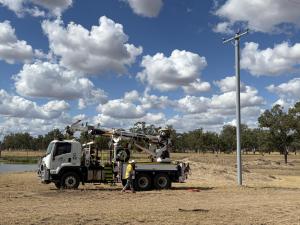
The lightweight nature of FRP allows more poles to be transported in a single load, creating opportunities to reduce vehicle movements and improve logistics.
Once the poles reach site, Michael says the benefits continue.
“There’s a multiple hour saving on each pole that we stand over our current practices.”
For large-scale pole replacement programs, efficiencies at an individual pole level have the potential to become significant when repeated across hundreds or thousands of installations.
Finding Where FRP Delivers the Greatest Benefit
Energy Queensland is also looking strategically at where the characteristics of FRP can provide the greatest advantage.
Western Queensland is one example, where transport distances and large replacement programs make lightweight infrastructure particularly attractive.
Termite-prone areas provide another potential application, with FRP unaffected by termite attack.
Remote island networks present their own challenges.
Around Thursday Island, vehicles, equipment and materials need to be transported by barge, making the weight and transportability of infrastructure an important consideration.
FRP’s resistance to corrosion and termite attack also means poles can be stored in remote environments without the same concerns associated with deterioration of some traditional materials.
Together, these characteristics allow Energy Queensland to consider FRP not simply as an alternative pole material, but as a solution that can be targeted to particular network environments and operational challenges.
Winning Over the People Who Use Them
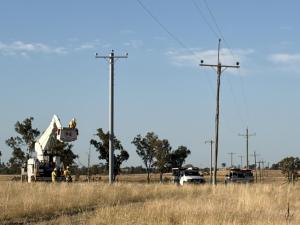
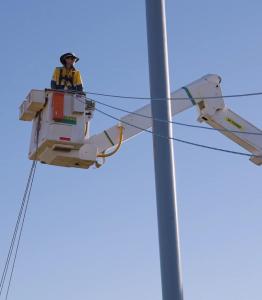
Perhaps one of the strongest indicators of successful adoption has come from the people installing the poles.
Michael acknowledged that introducing a different material can naturally generate some initial uncertainty among field crews.
But experience has helped change perceptions.
“Once they’ve used the product and stood it and worked on it, it’s been almost universally accepted as being a really significant step forward.”
For Michael, that response from crews has been one of the most encouraging aspects of the program.
Engineering performance and material properties are important, but successful adoption also depends on how new infrastructure performs in the hands of the people working with it every day.
Learning From Utilities Already Using FRP
Michael’s advice to other electricity networks considering FRP is straightforward: speak to utilities that already have experience with the technology.
Energy Queensland did exactly that, drawing on the experience of Essential Energy as it developed its own approach.
The message they received was refreshingly simple.
“Don’t overcomplicate it.”
Rather than treating FRP as something requiring an entirely new way of constructing a network, the focus was on understanding the material and integrating it into established network practices.
That shared industry experience helped Energy Queensland build confidence in the technology and address some of the uncertainty that naturally accompanies the introduction of a different pole material.
From Alternative Material to Network Opportunity
What began partly as a response to potential timber supply constraints has evolved into a much broader conversation for Energy Queensland.
Transport efficiency, installation productivity, termite resistance, corrosion resistance and suitability for remote environments are all contributing to where and how FRP utility poles are being considered.
Most importantly, practical experience is building confidence.
As electricity networks continue replacing ageing infrastructure, Energy Queensland’s experience demonstrates the value of looking beyond the pole itself and considering how material selection can influence the entire journey — from transport and storage through to installation and long-term network operation.
Watch the full interview with Energy Queensland Network Manager Michael Derrick to hear directly about the network’s experience adopting FRP utility poles.