A blog by Wagners CFT Structural Engineer, Sabin Raut (Connect via LinkedIn)
In any structure, connections are where performance is won or lost. That principle becomes even more critical in Fibre Reinforced Polymer (FRP) systems.
Fibre Reinforced Polymer (FRP) members are exceptionally strong, lightweight, and corrosion resistant. But they behave differently to steel or solid timber sections, particularly in the transverse direction and under concentrated loads. The connection is the point where forces transition from deck to bearer, from bearer to column and ultimately from the superstructure into the foundation. If that force transfer is not detailed correctly, the intended load path is disrupted. As a result, forces may redistribute in unintended ways, compromising the efficiency of the entire system.
Connections must effectively transfer axial forces, shear, bending, bearing, and dynamic loads between members and ultimately into the foundation while preserving the integrity of the laminate.
Over the years, our team at Wagners Composite Fibre Technologies (CFT), has refined our approach to connection detailing. In earlier projects, crush blocks were specified conservatively and often universally. Through testing, field feedback, and installation experience, we have learned that not every connection requires the same level of reinforcement. By reducing unnecessary crush block use where appropriate, we have improved constructability, reduced installation time, and delivered cost efficiencies without compromising structural performance.
The key is understanding when to use a crush block, a bush (sleeve), or a rivet and your connection choice is not about preference, it is about engineering intent.
Understanding the Connection Types
Crush Blocks / Anti-Crush Inserts
Crush blocks, sometimes referred to as anti-crush inserts, are internal reinforcement components installed inside hollow FRP sections at bolt locations. Crush blocks are most appropriate when:
- Compressive or bearing loads are high
- Long-term bolt preload must be maintained
- Shear capacities need to be maximised
- Pull-out resistance is critical
- The dominant stresses act transverse to fibre orientation
- Wall buckling of thin-walled sections is a risk
They are particularly effective in hollow sections (SHS, RHS), where localised bearing from bolts can otherwise cause laminate crushing.
Benefits of using crush blocks include:
- Prevention of local crushing of the laminate
- Maintain bolt tension over time
- Improved fatigue performance
- Increased shear, bearing, crushing, and pull-out capacities
- Enhanced transverse connection performance (where FRP is inherently weaker)
- Flexibility to combine adhesives and mechanical fasteners for higher shear capacities
- Prevention of wall buckling in thin-walled profiles
In high-demand structural joints, such as primary beam-to-column interfaces, crush blocks provide the most robust solution.
Limitations of using crush blocks include:
- Additional handling during installation
- Slower installation compared to bushes or rivets
- Not always structurally necessary
- Typically proprietary components
- Installation of crush block with adhesives requires factory environment
Using a crush block where loads do not justify it may add cost and time without proportional benefit.

Bushes / Sleeves
Bushes or sleeves are cylindrical inserts positioned within bolt holes to distribute load and protect the laminate. Bushes are suitable where:
- The dominant force is longitudinal (along the fibre direction)
- Sections are smaller
- Pull-out forces are minimal
- Crushing demand is low
- Bolt torque needs to be improved
They are commonly used where stress concentrations around bolt holes need to be reduced, but full transverse reinforcement is unnecessary.
Benefits of using bushes include:
- Distribute local stresses around bolt holes
- Protect laminate from bolt-induced damage
- Improved bolt torque and tightening capacity
- Increased bolt shear capacity
- Easier and faster to install than full crush blocks
In many secondary connections, bushes offer a balanced solution between structural enhancement and constructability.
Limitations of using bushes include:
- Limited improvement in transverse bolt capacity
- Typically require oversized washers to maintain pull-out performance
- Risk of metallic corrosion if bush and bolt materials are incompatible
- Do not significantly enhance crushing resistance in high-load conditions
Bushes are not a substitute for crush blocks in heavily loaded joints.

Riveted Connections
Riveted connections are typically used in permanent, in-plane applications. Rivets are ideal when:
- Loads are low to moderate
- Joints are permanent
- Access is limited
- In-plane force transfer dominates
They are particularly effective in handrails, balustrades, and secondary attachments.
Benefits of using riveted connections include:
- Fast installation
- Reduced handling
- Reduced misalignment issues common with bolts
- Tight, consistent joints
Limitations of using riveted connections:
- Limited disassembly or maintenance flexibility
- Not suited to high pull-out or crushing demands
- Lower ultimate capacities compared to bolted systems with inserts
Rivets prioritise speed and simplicity over ultimate strength.

Key Factors in Choosing a Connection
Selecting the right detail requires systematic evaluation including load magnitude, direction and type, section geometry, installation considerations, environmental conditions, maintenance and long-term serviceability.
1. Load Magnitude, Direction, and Type
When considering load magnitude, direction and type think about:
- Tension
- Shear
- Bending
- Bearing / crushing
- Dynamic or fatigue loading
- Longitudinal vs transverse force direction
If your pull-out forces are high, go for a crush block. If they are moderate pull-out, think about using a bush and if your pull-out risk is low consider riveted connections. And same if your bearing stress is high, choose a crush block first. If your bearing stress is moderate, consider a bush or rivet connection.
2. Section Geometry
Connection performance in FRP is highly dependent on the geometry of the section being connected. Unlike isotropic materials such as steel, fRP behaves differently depending on fibre orientation and laminate build up, so geometry matters more than many engineers initially assume. When evaluating section geometry consider:
- Wall thickness
- Hollow vs solid profile
- Fibre orientation
Thin-walled hollow sections with transverse load demand tend to favour crush blocks. Thicker sections, solid members or connections dominated by longitudinal forces may only require bush or in some cases, rivets.
3. Installation Considerations
Even the most structurally sound connection detail must also be practical to construct. Installation realities often influence the most appropriate solution. When assessing constructability consider:
- Access limitations
- Sequencing constraints
- Bolt spacing (<100 mm)
- Tolerances and alignments
If access is restricted and loads are low to moderate, rivets are often the most efficient solution. Where bolt performance needs enhancement but full reinforcement is unnecessary, bushes provide a practical middle ground.
4. Environmental Conditions
Fibre Reinforced Polymer (FRP) is inherently corrosion resistant; one of its greatest advantages over steel. However, connections still require careful environmental consideration including:
- Moisture exposure
- UV
- Temperature variation
- Corrosive environments
In aggressive environments such as coastal boardwalks or wastewater facilities, conservative detailing may still favour crush blocks in critical joints due to their ability to maintain structural integrity over long service lives.
5. Maintenance and Long-Term Serviceability
Connection detailing must also consider what happens after installation. Make sure to ask the following:
- Will the joint require periodic inspection?
- Is disassembly likely?
- Is long-term preload retention critical?
- What is the intended design life of the structure?
From a lifecycle perspective, crush blocks offer the highest structural security in demanding joints. Bushes provide enhanced bolt performance where moderate serviceability is required. Rivets deliver efficiency where permanence and simplicity are acceptable.
A Practical Decision Framework
The following table is not prescriptive, but provides a rational starting point. The correct approach is to evaluate each connection point individually, not assume uniform detailing across the structure.
| Condition | Preferred Solution |
| High pull-out/shear force | Crush block |
| Moderate pull-out/shear force | Bush |
| Low pull-out/shear force | Rivet |
| High bearing stress | Crush block |
| Moderate bearing stress | Bush |
| Close bolt spacing | Bush, Rivet or Crush block (case dependent) |
| Limited access | Rivet, Bush, Crush block |
Real-World Application: Boardwalk and Bridge Projects
In boardwalk and bridge applications, connection detailing has a measurable impact on installation time and performance.
Handrail Post Connection Example
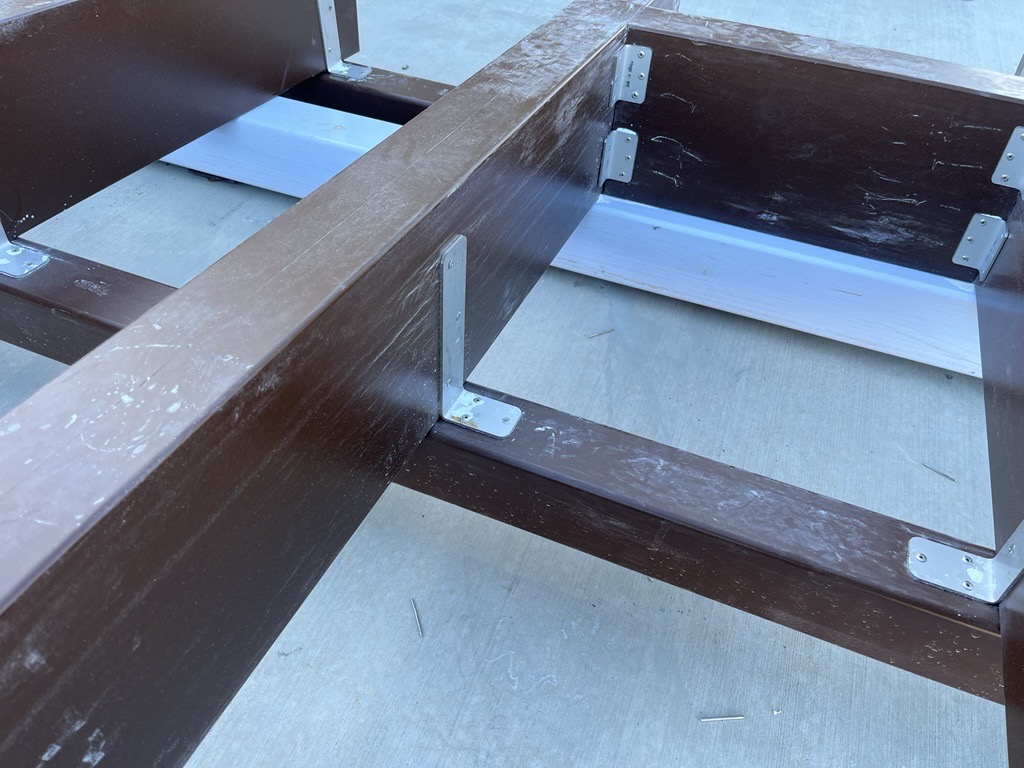
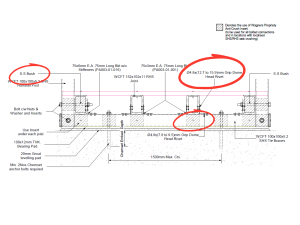
In one project, a 125 SHS joist connection utilised a bush detail rather than a crush block. This eliminated the need to push inserts to the centre of the joist significantly improving constructability.
On the flip side, earlier projects like Beree Badalla, crush blocks were used within joists as a conservative measure. While structurally sound, installation required more handling and time.
Through testing and experience, we recognised that the load case did not justify full transverse reinforcement. The bush solution provided adequate performance while delivering tangible installation efficiencies.
This is the evolution of smarter detailing applying reinforcement only where engineering demands require it.
Performance and installation impacts of using bushes in low-impact connections instead of crush blocks included:
- Reduced labour time
- Simplified sequencing
- Lower material handling
- Maintained structural reliability
Connection choice directly influences program certainty and cost control.
The Bigger Picture: Engineering with Intent
Connection detailing is not one-size-fits-all. Over-reinforcing every joint increases cost and slows installation. Under-reinforcing risks long-term performance. The balance lies in understanding load paths, laminate behaviour, and constructability constraints.
Smarter detailing improves:
- Structural efficiency
- Reliability
- Installation speed
- Lifecycle durability
At Wagners CFT, our approach is informed by testing, field data, and continuous improvement. The reduction of unnecessary crush blocks is not a compromise; it is evidence of engineering maturity.
Looking Forward: The Future of FRP Connections
The next generation of FRP connection systems will likely include:
- Co-moulded inserts integrated during pultrusion
- Sensor-embedded connections for structural health monitoring
- Recyclable or modular connection components
- Hybrid adhesive-mechanical systems optimised for fatigue
As composite structures become more mainstream, connection innovation will accelerate.
Conclusion
Choosing between a crush block, bush, or rivet is not a matter of preference, it is a matter of engineering judgement.
- High load, high consequence → Crush block
- Moderate demand, improved torque and shear → Bush
- Low load, limited access, permanent joint → Rivet
Each connection must be evaluated based on load, geometry, environment, and serviceability.
When detailed correctly, FRP structures achieve exceptional durability, efficiency, and longevity. When connections are optimised, we unlock the full potential of the material.
The future of FRP is not just in the profiles, it is in the precision of how we connect them. And smarter connections lead to stronger outcomes.