

An innovative approach to electric vehicle (EV) charging is taking another significant step forward, with the Australian Energy Regulator (AER) granting Essential Energy approval to progress a trial involving 300 composite streetlight columns with integrated EV chargers across regional New South Wales.
The decision marks an important milestone for Wagners Composite Fibre Technologies (CFT), which has worked alongside Essential Energy to develop Fibre Reinforced Polymer (FRP) infrastructure capable of integrating EV charging technology directly into streetlight columns.
The initiative forms part of Essential Energy’s Plug and Play program, supported by the Australian Renewable Energy Agency (ARENA), which aims to improve access to public EV charging infrastructure across regional, rural and remote communities.
From Innovation to a Larger-Scale Trial
On 29 October 2026, the AER granted Essential Energy a time-limited regulatory waiver allowing the electricity distributor to install, own, maintain and lease 300 EV chargers embedded within composite streetlight columns.
The approval enables Essential Energy to trial a new model for delivering public charging infrastructure, with private charge point operators responsible for providing charging services to customers.
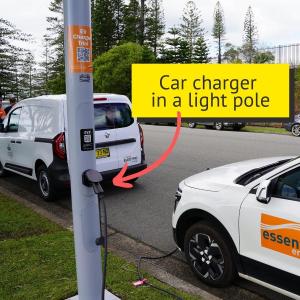
The proposed 7kW chargers will be integrated directly into specially designed composite streetlight columns, providing a compact alternative to conventional standalone charging infrastructure.
For regional communities, this approach has the potential to expand charging availability in locations where traditional pole-mounted chargers may not be suitable or where access to public charging facilities remains limited.
Building on Earlier Success
This latest development builds on the collaborative work undertaken by Essential Energy, Wagners CFT and EV charging technology provider EVX.
In 2024, the organisations partnered to develop and trial an innovative streetlight EV charger in Port Macquarie, NSW.
The prototype incorporated EV charging equipment within a purpose-designed FRP streetlight column, demonstrating how existing electricity infrastructure could support additional functionality while minimising the need for separate charging structures.
The trial provided valuable insights into the practical application of composite technology, helping inform further development of integrated EV charging solutions.
The progression from an initial proof of concept to a proposed 300-unit trial demonstrates the potential for innovation and collaboration to support new infrastructure applications.
The Role of Composite Infrastructure
FRP technology offers several advantages for infrastructure applications, including lightweight construction, corrosion resistance, durability and design flexibility.
For integrated EV charging applications, the ability to manufacture purpose-designed composite columns creates opportunities to accommodate electrical equipment within the structure itself.
Rather than treating streetlighting and EV charging as entirely separate infrastructure requirements, this approach explores how multiple functions can be incorporated into a single asset.
For network operators and local councils, such innovations have the potential to support more efficient infrastructure deployment while reducing the need for additional street furniture.
Supporting the Future of Regional EV Charging
Improving access to EV charging remains an important consideration for regional communities, particularly as electric vehicle adoption continues to grow.
Essential Energy’s Plug and Play program aims to address some of these challenges by making electricity network infrastructure more accessible to charging operators and supporting the development of commercially viable charging solutions.
For Wagners CFT, the AER’s decision represents another significant step in demonstrating how Australian-made composite infrastructure can contribute to emerging energy and transport applications.
Through continued collaboration with Essential Energy and industry partners, Wagners CFT is proud to support the development of innovative infrastructure solutions that respond to the evolving needs of Australian communities.
As the trial progresses, the project offers an important opportunity to further demonstrate the role of composite technology in supporting the next generation of electricity infrastructure.