Wagners Composite Fibre Technologies (CFT) produces the most durable, safe and environmentally friendly new composite utility poles for energy infrastructure across Australia, New Zealand and the world. A utility pole made from Wagners Fibre Reinforced Polymer (FRP) meets all stiffness requirements. Other added advantages are that an FRP pole will be inert which means they will not react chemically to their surroundings. This makes them resistant to rot, rust and corrosion caused by moisture, chemicals and UV radiation. FRP poles are able to withstand severe weather, including high winds. They have a long life expectancy due to their incredible structural integrity, making them an extremely competitive option for the utility industry. Get started in solving your utility pole, power pole and distribution pole needs and contact us today.
Learn from Energy Queensland’s experience
What does it take to successfully introduce a new utility pole material into an electricity distribution network?
In this video, Energy Queensland’s Chief Engineer, Suzanne Shipp, and Lineman and Work Group Leader, Jeremy Thomas, share their experience from the Roma–Injune line project, discussing why FRP utility poles were selected, what the team learned during deployment and how the technology is supporting a safer, more resilient electricity network.
For utilities, engineers and asset managers considering the future of their pole fleet, this case study provides valuable operational insights from one of Australia’s largest electricity network operators.
Hear directly from the people delivering the project and discover how innovation, collaboration and practical field experience are helping shape the next generation of utility infrastructure.
Watch the video now for more detail.
From Pultrusion to Power On
Wagners CFT produces the most durable, safe and environmentally conscious utility poles for infrastructure asset owners around the world.
Our uniquely pultruded FRP utility poles are safer than traditional poles because they do not conduct electricity, thereby reducing the risk associated with shock or electrocution, especially during the installation phase. As they are non-conductive, FRP utility poles are also the clear choice for areas with high electrical activity such as near transformers and high voltage power lines or substations.
Being 50 percent lighter than poles made from traditional materials, FRP utility poles are safer to handle, transport and install. This leads to improved health and safety for both workers and the community during installation, reduced wear and tear on equipment and improved transport efficiencies.
Watch the video to find out more.
Benefits of Choosing FRP
- Durable – with an expected 80-year design life
- Inert – fully resistant to rot, rust and corrosion
- Resistant to termites and acid sulfate soils
- Lightweight, making it safer to handle, transport and install
- Modular by design so can be assembled off-site and craned or trucked into place saving you onsite time and expenses whilst reducing weather impacts to your project
- Cost effective – with reduced maintenance and replacement cycles resulting in significant savings over the lifetime of the structure
- Non-leaching, so will not release harmful substances into the environment making it suitable for areas of high conservation value
- Plus, structures made from FRP contribute to decarbonisation in construction and reducing global warming through less embodied carbon making for a more positive environmental impact
Read more about Wagner CFT’s Environmental Product Declaration (EPD).
Lessons from the world’s longest FRP utility pole span
What does it take to design an overhead line spanning approximately 746 metres?
In this mini doc, you will discover how Vector’s engineering team delivered what is believed to be the world’s longest span achieved using an FRP utility pole. Filmed on Kawau Island, New Zealand, the project demonstrates how lightweight composite infrastructure, rigorous engineering validation and innovative design combined to solve a complex network challenge.
📺 Watch the story behind a project that is helping redefine what is possible for modern electricity networks.
Added Benefits of FRP Utility Poles
FRP products can withstand extreme weather, high temperatures and are even fire resistant. FRP utility poles have been engineered to withstand extreme loads, such as high winds and storms, making them a resilient choice in regions where traditional poles may fail or need to be replaced frequently.
A composite pole is recognised as maximising network security and resilience. FRP composite poles are extremely durable with an expected 80-year design life. For comparison’s sake, steel poles, wood poles and concrete poles generally last much less, especially in highly corrosive environments. Their low-maintenance nature leads to reduced inspection schedules, fewer site visits and long-term savings on labour costs. Wagners FRP utility poles are also non-leaching which means they are perfect for areas of high conservation value as they will not leach nasty toxins and chemicals into the environment.
Wagners’ Environmental Product Declaration (EPD) demonstrates our commitment to environmental transparency and decarbonisation in construction; with our FRP utility poles providing a carbon conscious alternative to traditional materials. Superior return on investment is achieved through its long service life owing to reduced maintenance and inspection requirements.
At Wagners, our Research and Development team are always testing and trialling our products including performing cantilever tests to ultimate failure to show the strength and stiffness of our utility poles. Our tests have assured us that we have the strongest composite utility poles on the market.
Installation tips, benefits for linesmen and pathway to network security
Discover installation tips, benefits to linesmen and the pathway to network security as Wagners CFT talk to Wolff Power General Manager, Colin Dennis about installing FRP utility poles.
Dennis explains techniques Wolff Power has developed for the installation of FRP poles, how easy it is to transition to FRP from traditional poles and the many benefits to linesmen including improved safety and efficiencies during installation as well as long term positive business outcomes.
Watch the video now for more detail.
Upgrading electricity networks in remote, cultural and environmentally sensitive areas
The mission was to install 38 Wagners Fibre Reinforced Polymer (FRP) utility poles on Kawau Island in the Hauraki Gulf of New Zealand quickly and efficiently so as to limit disruption of supply to the 80 permanent residents. And consider the core values of Kaitiakitanga: to care for and protect the land, water and natural resources for future generations.
Wagners Composite Fibre Technologies (CFT) FRP Utility Poles have an:
- 80-year design life
- are lightweight, reducing costs for transport and installation
- Recyclable, minimising waste and promoting sustainability
- Energy Efficient, less energy to produce than traditional poles
- Non-toxic and inert, suitable for use in high conservation areas
Wagners CFT also has an Environmental Product Declaration (EPD), which is third party verified and internationally recognised.
Watch the video to find out more.
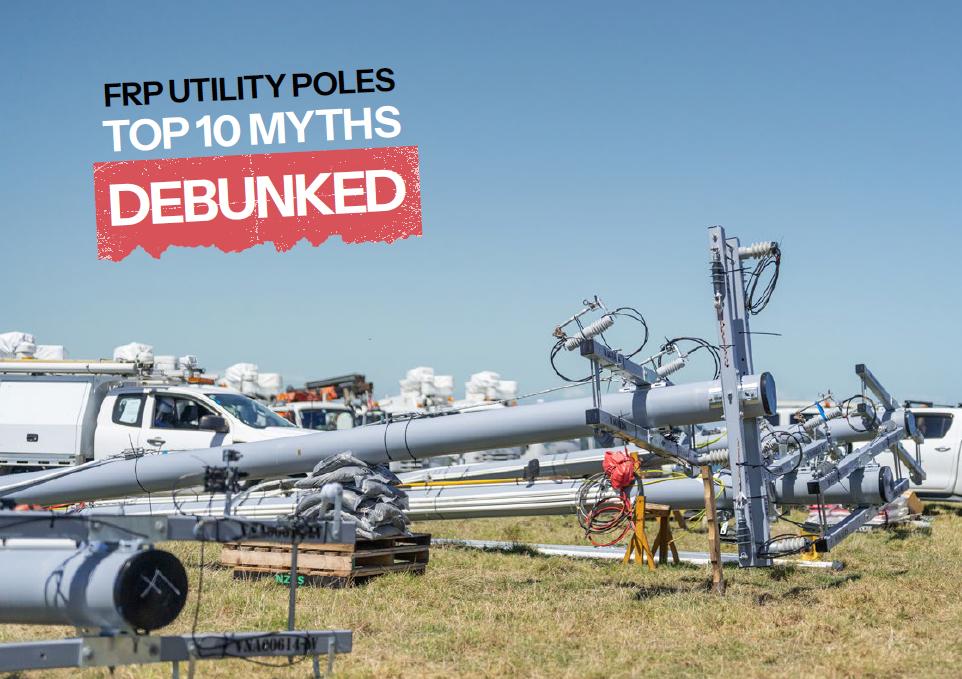
Debunking the Top 10 Myths About FRP Utility Poles
In this clear and informative guide, Wagners CFT dismantle 10 common myths about Fibre Reinforced Polymer (FRP) utility poles, demonstrating how modern composite technology outperforms traditional materials like wood, steel and concrete in durability, safety and environmental performance.
MYTH: FRP composite poles aren’t strong enough for utility applications.
FACT: FRP poles are already in active service in diverse, demanding environments worldwide – including wildfire zones, cyclone and hurricane-prone coastal areas, remote mountainous regions, salt-exposed marine settings and flood prone lowlands – attesting to their robustness and resilience.
Read the full document now to find out more.
A new era for remote line construction in New Zealand: Dome Valley’s composite H-frame installation
How do you build overhead line infrastructure in one of New Zealand’s most challenging environments?
This case study explores the installation of 13 Fibre Reinforced Polymer (FRP) H-frame structures at Dome Valley, showcasing how lightweight composite infrastructure is helping transform remote line construction.
Follow the project from planning through to installation and discover how innovative engineering, prefabrication and FRP technology are improving safety, efficiency and constructability for modern electricity networks.
Watch the video to find out more.
More information
Low Maintenance Requirements
Our composite structures are uniquely suited to withstand the harshest environments while providing an easily maintained, long life asset. FRP is a durable, safe and environmentally friendly material with an expected 80-year design life in its application as a composite utility pole. Unlike wood poles, which are vulnerable to rot, insect attack and environmental degradation, Wagners fibreglass poles are completely inert, resisting termites, moisture, chemicals and UV exposure for unmatched durability.
Our FRP utility poles are designed to meet the structural demands of power transmission applications, including the ability to withstand high wind loads without compromising performance or longevity. Even in coastal or marine environments, FRP can outperform traditional materials.
One of the great advantages of FRP infrastructure is its reduced ongoing maintenance requirements compared to steel and timber. A composite utility pole is cost-effective over the duration of its lifetime. This is often expressed as the Total Cost of Ownership (TCO) of a structure.
Installing FRP Utility Poles
Being 50%+ lighter than traditional poles, FRP utility poles are safer to handle, transport and install leading to improved health and safety for workers during installation, reduced wear and tear on equipment with improved transport efficiencies and potentially lower transportation costs. Being light weight has the added bonus of being easier to transport into remote locations that would normally be hard to access.
Our uniquely pultruded Fibre Reinforced Polymer (FRP) utility poles are safer than a traditional steel, concrete or timber pole because they are made from materials that are non conductive, reducing the risk associated with shock or electrocution, especially during installation. This makes FRP utility poles the clear choice for areas with high electrical activity such as near transformers or high voltage power lines and substations.
Existing equipment and processes are fully compatible with composite utility pole installation so there’s no need to upgrade or expand existing assets. Long-term, lighter equipment can be utilised to install utility poles which translates to reduced future capital expenditure. Onsite fitting and installation are no different to traditional timber poles with the ability to drill fixtures in-field, ensuring a quality fit every time.
For further information download our Wagners CFT Utility Pole Brochure.
Manufacturing process for utility poles
As composite utility pole manufacturers, we start with our Wagners CFT unique pull-winding, where the glass is pulled through the die. We use a resin injection process before the material is pulled through the heating die, where the resin is cured, producing a product that is fully solid. At the end it is cut off by a saw to the length required.
The pole processing team then sprays the poles with a fluoropolymer coating and are baked to cure the paint. After that, the end caps are put on and any required product information is stencilled on the pole and then it is ready to be delivered for installation.
Find out more about our FRP manufacturing process.
What makes FRP the right choice?
At Wagners CFT, we utilise a pull winding process called ‘pultrusion’ to manufacture our FRP structural profiles. These profiles mirror the geometry of traditional circular and square hollow sections, but are composed of fibreglass reinforcements and vinyl ester resins. FRP is an exceptional material that surpasses steel in strength while meeting all stiffness criteria.
Our FRP structural profiles boast an impressive Elastic Modulus of 40 (E40), significantly higher than that of our competitors. Furthermore, with an unrivalled glass content of 76%, our pultruded FRP structural profiles rank among the strongest in the world. We have established a reliable network of primary raw material suppliers globally, ensuring we produce the most robust FRP structural profiles for our customers while maximising cost efficiency.
Discover more about our high performance solution in our detailed FRP vs Steel comparison.
Working with Wagners
Wagners CFT has produced more than a million FRP electrical crossarms for network operators over the past 20 years. We have built our composite utility pole market through our reputation of quality, safety and reliability. The collective characteristics of Wagners CFT fibreglass composite poles for the utility industry will further enhance and maximise network security and resilience for asset owners and customers into the future.
Wagners CFT are also able to help with providing electrical cross arms and light poles.
Have a project in mind?
Book a project deep dive with us and work through your projects plans and problems with the experts!