

FRP Utility Pole Installation
Fibre Reinforced Polymer (FRP) utility poles from Wagners Composite Fibre Technologies (CFT) are transforming the way utility infrastructure is built. Unlike traditional timber, concrete or steel poles, our composite fibre poles are lightweight, strong and easy to manoeuvre, making installation faster, safer and more efficient. Linesmen are already noticing the difference as more projects benefit from the simplicity and reliability of Fibre Reinforced Polymer poles.
Engineered for durability and consistency, these poles eliminate common timber issues such as knots, cracks and splitting, while retaining all the structural requirements for modern energy networks. Despite being a composite material, the installation process is almost identical to timber poles, with only two small adjustments: the use of a special lifting strap designed for FRP and a specific drill bit for pre-drilling hardware points.
How are utility poles installed when choosing Wagners FRP poles? The answer is very similar to that of a timber pole. All the details are outlined right here.
FRP Power Pole Installation Process
1. Site & Pole Preparation
Installation begins just like with traditional timber or concrete poles. The correct FRP pole is selected based on height, load and environmental conditions. Hardware such as crossarms and components for earthing can all be pre-fitted before lifting, just like you would with a timber pole. Existing poles, if present, should have the overhead power lines carefully disconnected, and the foundation or hole should be prepared according to standard engineering requirements.
A specialised drill bit is used for precise hardware installation on FRP utility poles.
2. Hardware Installation
Using a drill bit designed for FRP, mounting points for crossarms and hardware are pre-drilled with precision. Unlike timber poles, which may have knots or cracks, the FRP poles’ uniform, defect-free surface means connection points are precise and hardware aligns exactly as intended. Lightweight handling continues to reduce strain, making the installation faster and safer.
Instead of chains, a sling of webbed strapping with a rubber grip is used for FRP utility poles.
3. Effortless Lifting and Positioning
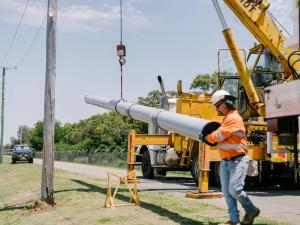
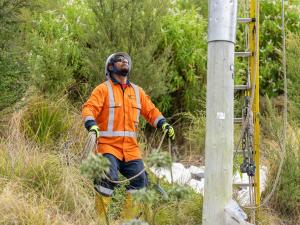
The real difference comes with handling FRP poles. Thanks to their lightweight construction, a single linesman can manoeuvre even a 12 kN pole with ease, often reducing the need for extra personnel. FRP poles can be rotated by hand for vertical drilling, allowing straighter, more precise holes for hardware.
To lift the pole safely, a special FRP webbing sling is used. Unlike heavy, overheated or slippery chains (required for timber poles), this sling is lightweight, clean and slip-resistant, even when the pole is wet. It can also function as a cant hook, giving linesmen maximum control while positioning the pole.
4. Backfilling and Compaction
Once the pole is aligned and hardware is in place, the hole is backfilled in stages, exactly as with traditional poles. Initial backfill is compacted with a hydraulic tamper, then continued until full, ensuring a solid, stable foundation.
5. Reconnections
Finally, conductors, earthing and other electrical components are reconnected. The lightweight and manoeuvrable design of FRP poles allows teams to complete these steps efficiently, without heavy lifting or complex adjustments, ensuring the pole is fully operational and installed properly.
After the pole is installed safely, the poles are ready to perform like any other utility pole but with far less ongoing maintenance, minimal risk of splitting and resistance to water ingress, corrosion or rot.
Why Our Composite Power Poles Are Easier To Install Than Timber & Concrete Poles
What sets FRP utility poles apart is how effortlessly they can be handled from start to finish. Their reduced weight means fewer people and less equipment are needed for transport and lifting, while the smooth, uniform surface makes alignment and positioning simple. Unlike timber, there are no knots or cracks to worry about, so pre-fitting hardware is predictable and precise.
The only differences from timber or concrete poles are minor: a lifting strap specifically for FRP poles and a drill bit designed for composite material. Beyond these small adjustments, linesmen can install FRP poles exactly as they would a traditional pole, but with far less effort, less strain and more confidence in long-term performance. Lightweight handling also improves safety for crews, reducing the risk of injuries during transport, lifting and alignment.
Timber poles demand regular maintenance and require you to inspect the poles regularly. Because FRP poles are resistant to rot, corrosion and splitting, there is minimal maintenance required post-installation, saving time and costs over the asset’s life. Learn more about the total cost of ownership in FRP products.
How long does it take to install a utility pole?
Installing a Wagners FRP utility pole typically takes half the time required for timber or concrete. The poles’ lightweight construction and simple handling process mean crews can lift, position and secure them with ease. With fewer steps and reduced manual strain, FRP poles streamline installation from start to finish.
How to get a utility pole installed from Wagners CFT
Wagners FRP composite utility poles deliver effortless installation, reliability and long-term durability. From lighter lifting and easy manoeuvring to precise hardware installation, these poles offer all the functionality of timber or concrete but with less effort, faster deployment and reduced exposure to safety or electrical hazards.
Choosing Wagners CFT as your manufacturer and supplier of FRP poles means smoother projects, safer crews and long-term cost savings. Whether you are a council, contractor or utility company, Wagners FRP poles provide a more efficient solution for overhead power lines and infrastructure projects.
Talk to Wagners CFT about your utility pole needs.
Download the Utility Poles Brochure