
a blog by Wagners CFT, SA/NT/WA Business Development Manager, Robbie Westley (Connect via LinkedIn)
Fibre Reinforced Polymer (FRP) structural profiles are increasingly specified across infrastructure, utilities, marine, transport and industrial applications due to their corrosion resistance, high strength-to-weight ratio, electrical insulation properties and long service life. However, not all FRP is created equal.
One of the most common and most misunderstood quality issues affecting FRP structural profiles is blooming. Often dismissed as a cosmetic defect, blooming can in fact be a visible symptom of deeper material formulation and manufacturing deficiencies that compromise long-term durability, structural performance and whole-of-life value.
Understanding what blooming is, what causes it, and why it matters is essential for asset owners, engineers and specifiers seeking reliable, long-term FRP solutions.
What Is Blooming in FRP?
Blooming refers to the formation of a white, chalky, powder-like residue on the surface of FRP profiles over time. It may appear as:
- A dull or faded surface finish
- A chalky film that rubs off onto hands or clothing
- Patchy whitening, particularly on sun-exposed faces
- Uneven surface texture or loss of gloss
Blooming typically develops after prolonged exposure to UV radiation, moisture, temperature cycling, or chemical environments, and is most noticeable on externally exposed FRP structural elements such as beams, grating, handrails, poles, piles and bridge components.
While blooming is often first observed as a surface issue, it is rarely “just cosmetic.”
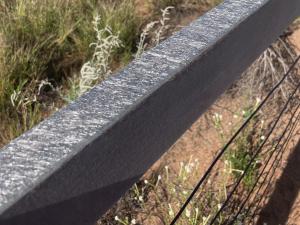
Pictured – Blooming refers to the formation of a white, chalky, powder-like residue on the surface of FRP profiles over time which typically develops after prolonged exposure to UV radiation, moisture, temperature cycling or chemical environments.
What Causes Blooming in FRP Structural Profiles?
Blooming is the result of chemical and physical degradation mechanisms within the resin system and at the fibre-matrix interface. The most common contributing factors include the following.
1. Resin Degradation and Poor UV Stability
The polymer resin is the protective matrix that binds the fibres together and shields them from environmental attack. If the resin system lacks sufficient UV inhibitors, stabilisers, or weathering resistance, prolonged sun exposure causes:
- Breakdown of polymer chains
- Migration of low-molecular-weight compounds to the surface
- Oxidation of the resin matrix
These degradation products manifest as the chalky residue known as blooming.
Lower-cost polyester resins, or poorly formulated vinyl ester systems, are particularly susceptible if UV resistance has not been properly engineered.
2. Inadequate Surface Veil or Resin-Rich Layer
High-quality FRP structural profiles typically incorporate a surface veil or resin-rich outer layer designed to protect structural fibres from UV, moisture and chemical attack.
Blooming commonly occurs when:
- The surface veil is absent or too thin
- Fibre print-through occurs
- Glass fibres are exposed at or near the surface
- Resin starvation exists at the exterior layer
Without adequate surface protection, fibres act as wicks, drawing moisture into the laminate and accelerating resin breakdown.
3. Moisture Ingress and Hydrolysis
Water penetration, particularly in humid, marine, or wet-dry cycling environments, can trigger hydrolysis, a chemical reaction that breaks down ester bonds in susceptible resin systems.
This leads to:
- Loss of resin integrity
- Migration of degraded compounds to the surface
- Reduced fibre-matrix bonding
Blooming is often more pronounced in tropical, coastal or wastewater environments where moisture exposure is continuous.
4. Inferior Manufacturing Control
Blooming is frequently a symptom of inconsistent or poor manufacturing practices, including:
- Incorrect resin-to-fibre ratios
- Inadequate curing or post-curing
- Temperature fluctuations during pultrusion
- Inconsistent line speeds or resin bath chemistry
Incomplete curing leaves unreacted compounds in the laminate that later migrate to the surface under heat and UV exposure, accelerating bloom formation.
5. Use of Fillers and Cost-Driven Additives
Some manufacturers introduce fillers, extenders or lower-grade additives to reduce material cost. These components may:
- Be incompatible with the resin system
- Leach out over time
- React adversely under UV or chemical exposure
The result is premature surface degradation and visible blooming, often well before the expected design life of the structure.
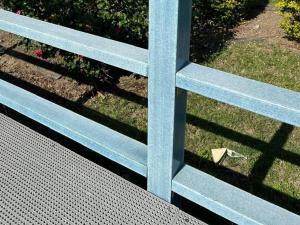
Pictured – Blooming in FRP profiles occurs when UV exposure, moisture ingress and poor resin or manufacturing quality cause degraded resin compounds to mitigate to the surface, leaving a chalky residue.
Why Blooming in FRP Is a Serious Issue
Although blooming is often first identified visually, its implications extend well beyond aesthetics.
1. Indicator of Ongoing Material Degradation
Blooming signals that the resin matrix is actively degrading. Once degradation begins at the surface, it can progressively move inward, affecting:
- Structural stiffness
- Load transfer between fibres
- Long-term strength retention
This is particularly critical in structural profiles where performance margins are tightly engineered.
2. Increased Moisture and Chemical Ingress
As the resin surface degrades, permeability increases. This allows:
- Water ingress
- Chemical penetration
- Accelerated fibre exposure
Over time, this can result in fibre swelling, micro-cracking, delamination and reduced service life.
3. Higher Maintenance and Lifecycle Costs
Bloomed FRP surfaces often require:
- Cleaning or surface treatment
- Protective coatings or sealers
- Premature replacement in severe cases
These interventions erode one of FRP’s primary value propositions: low maintenance over a long design life.
4. Aesthetic and Safety Concerns
In public-facing infrastructure such as bridges, boardwalks, platforms and handrails, blooming can:
- Make assets appear prematurely aged
- Reduce slip resistance consistency
- Create powder residue transfer to users
For asset owners, this translates to reputational risk and potential safety concerns.
5. Loss of Confidence in FRP as a Material Class
Perhaps most damaging is that blooming caused by inferior FRP products can unfairly undermine confidence in FRP as a whole when, in reality, blooming is not an inherent flaw of FRP, but a consequence of poor formulation and manufacturing discipline.
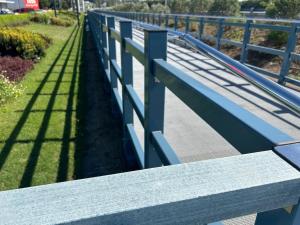
Pictured – At the bottom of the image you see an imported FRP profile which is significantly blooming compared to the Australian-made FRP profiles provided by Wagners CFT used on the second stage of this infrastructure project in Queensland.
Preventing Blooming: Why Manufacturing Quality Matters
Preventing blooming requires a holistic, engineered approach to resin chemistry, fibre architecture, surface protection and manufacturing control. This is where high-performance manufacturers clearly separate themselves from commodity FRP suppliers.
How Wagners CFT Prevents Blooming in Its FRP Structural Profiles
Wagners Composite Fibre Technologies (CFT) has built its reputation on producing structural-grade FRP engineered for long-term performance in the world’s harshest environments; from coastal infrastructure and marine structures to utility networks and heavy civil assets.
Blooming prevention is not treated as an afterthought at Wagners CFT; it is designed out of the product from the start.
1. Advanced Resin System Selection
Wagners CFT utilises carefully selected, high-performance resin systems, including premium vinyl ester formulations, specifically engineered for:
- UV resistance
- Hydrolytic stability
- Chemical exposure
- Long-term mechanical property retention
Resin chemistry is tailored to the application, ensuring the polymer matrix remains stable over decades of service.
2. Purpose-Designed Surface Veils, Resin-Rich Layers and Coated Profiles
Every Wagners CFT structural profile incorporates engineered surface protection, including:
- High-quality surface veils
- Controlled resin-rich outer layers
- Optimised fibre placement to prevent print-through
- Fluoropolymer or polyurethane coating for UV blockout
This ensures the structural fibres are fully encapsulated and shielded from environmental attack, dramatically reducing the risk of surface degradation and blooming. For more details on Why Wagners CFT Paint Their FRP Pultruded Profiles Instead of Just Using UV Inhibitors read this article.
3. Strict Pultrusion Process Control
Wagners CFT operates with tight manufacturing tolerances, including:
- Controlled resin bath chemistry
- Precise fibre-to-resin ratios
- Consistent line speeds
- Verified curing and post-curing protocols
This eliminates unreacted compounds, minimises internal stresses, and produces a fully cured, stable laminate resistant to long-term environmental exposure. Check out this 30-minute on demand webinar introducing Wagners CFT and explaining how we pultruded one of the world’s strongest FRP profiles.
4. No Cost-Driven Compromises
Unlike low-cost FRP suppliers, Wagners CFT do not rely on fillers or inferior additives that compromise durability. Every formulation choice is driven by performance, reliability and lifecycle value, not short-term material savings.
5. Proven Performance in Real-World Environments
Wagners CFT FRP profiles are deployed globally in:
- High-UV regions – Check out the Bicentennial Boardwalk project in Airlie Beach
- Coastal and marine environments – See Lea Lea Bridge in Papua New Guinea
- Chemically aggressive industrial sites – Check out Sulphur Point Boardwalk on Lake Rotorua in New Zealand
- Long-life utility and transport infrastructure – Watch this video of upgrading the electricity network on remote, cultural and environmentally sensitive Kawau Island in New Zealand
Decades of field performance validate that blooming is effectively mitigated when FRP is engineered and manufactured correctly.
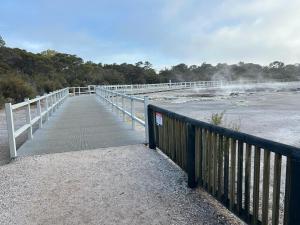
Pictured – Compare the original timber railing which looks burnt by the corrosive environment at Sulphur Point boardwalk on Lake Rotorua in New Zealand. In contrast, the Wagners FRP rails and boardwalk remain unaffected by the geothermal gases.
Why Wagners FRP Sets the Benchmark
Blooming is a clear dividing line between commodity FRP and true structural-grade composites. Wagners CFT sits firmly in the latter category.
By combining advanced resin science, engineered surface protection, disciplined manufacturing and real-world validation, Wagners CFT delivers FRP structural profiles that:
- Retain appearance and performance over time
- Resist UV, moisture and chemical degradation
- Maintain structural integrity across long design lives
- Minimise maintenance and whole-of-life costs
In short, Wagners CFT doesn’t just manufacture FRP; it engineers confidence. For more detail watch this video on ‘It’s What’s Inside That Counts’ featuring Wagners CFT Chief Technical Officer, Michael Kemp and Technical Lead Dr Ali Mohammed.
Conclusion
Blooming in FRP structural profiles is not inevitable. It is the result of avoidable compromises in resin selection, surface protection and manufacturing quality.
For asset owners and engineers seeking long-term performance, blooming should be viewed as an early warning sign, not a minor cosmetic flaw. Selecting a proven manufacturer with the technical capability and discipline to engineer blooming out of the product is critical.
Wagners CFT demonstrates that when FRP is done properly, it delivers on its promise: durable, low-maintenance, high-performance infrastructure materials built to last for generations.