
A blog by James Lorrimer, Global Utilities Lead – Wagners Composite Fibre Technologies (CFT) (Connect via LinkedIn)
A 746 metre overhead line span changes the conversation.
At that distance, a utility pole is no longer simply supporting a conductor. It becomes part of a highly loaded structural system, managing conductor tension, bending demand, stay forces, connection behaviour and long-term serviceability across a challenging and exposed environment.
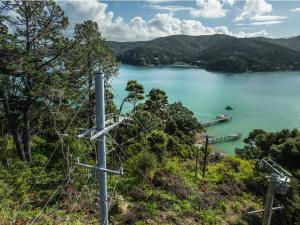
That was the engineering challenge presented on Kawau Island in New Zealand, where network provider Vector designed an 11kV long-span line between two points on the island using Wagners Composite Fibre Technologies’ (CFT) Fibre Reinforced Polymer (FRP) utility infrastructure.
The project utilised a 15 metre Wagners 356CHS FRP utility pole, a 2.4 metre Wagners FRP crossarm and three stay wires per pole to support a span of approximately 746 metres. To the best of our understanding, this now represents the world’s longest span achieved using an FRP utility pole.
More importantly, it demonstrates what becomes possible when innovative engineering is supported by rigorous testing and reliable product data.
A Strong Engineering Achievement by Vector
Long-span overhead line design is not straightforward.
Projects like this require careful consideration of conductor loading, terrain, structural behaviour, serviceability requirements and long-term network performance. Every component within the structure must work together as part of a complete load path.
In the case of Kawau Island, Vector’s design team delivered an impressive solution to a highly demanding network challenge.
For Wagners CFT, the project also highlights something equally important: the value of investing in technical validation and R&D before projects demand it.
Why Testing Matters in Composite Infrastructure
FRP utility poles offer a very different set of characteristics compared to traditional materials such as timber, steel or concrete.
They are lightweight, corrosion resistant and deliver an excellent strength-to-weight ratio, however their performance needs to be properly understood on its own terms.
This becomes even more critical in long-span applications.
At 746 metres, the pole is not acting in isolation. Forces move through the conductor, into the crossarm and hardware, through the pole, into the stay system and ultimately into the foundation. Every part of that system must be understood and validated.
For designers, this means more than simply reviewing a brochure or a material claim.
They need confidence in:
- Bending capacity
- Pole stiffness and deflection behaviour
- Bolt connection performance
- Washer/bolt pull-through behaviour
- Stay wire interaction
- Serviceability performance under working loads
That is exactly where Wagners CFT’s prior R&D program played an important supporting role.
Understanding the Pole System
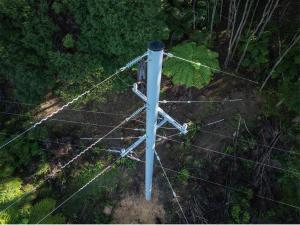
The Kawau Island project utilised Wagners CFT’s 356CHS FRP utility pole, featuring:
- 356 mm outside diameter
- 13.5 mm wall thickness
- 15 metre pole length
The circular hollow section offers strong structural efficiency, particularly where low weight, corrosion resistance and durability are important.
However, with hollow FRP structures, connection behaviour becomes critically important. Global strength alone is not enough. The localised interaction between bolts, washers, hardware and the pole wall must also be properly understood.
That is why extensive testing formed part of Wagners CFT’s development program.
Bending Capacity and Serviceability
One of the most important aspects of the R&D program was understanding the bending behaviour of the 356CHS profile.
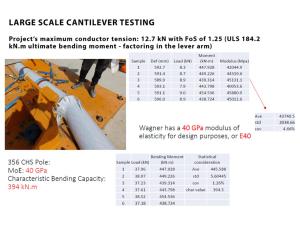
Large-scale cantilever testing confirmed:
- A design modulus of elasticity of 40 GPa (E40)
- A characteristic bending capacity of 394 kN.m
For the Kawau Island application, the maximum conductor tension was identified as 12.7 kN with a factor of safety of 1.25. Once lever arm effects were considered, the ultimate bending moment demand was calculated at 184.2 kN.m.
The previously validated bending capacity provided strong confidence in the suitability of the pole for the application.
Importantly, the testing also helped establish predictable serviceability behaviour. In long-span line design, stiffness and deflection can be just as critical as ultimate strength, particularly when maintaining conductor clearances and network geometry under working loads.
Connection Performance Matters
In long-span applications, the integrity of the connection system is critical.
A pole may possess adequate global bending strength, however if local connection behaviour is not understood, the overall structural load path can be compromised.
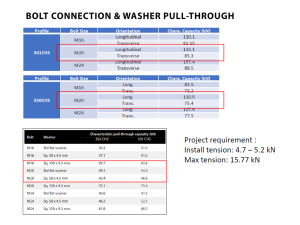
Wagners CFT’s testing program included bolt connection testing in both longitudinal and transverse directions using M16, M20 and M24 bolt configurations.
For the 356CHS profile, characteristic capacities achieved well above the project’s loading demands, helping provide confidence in the localised performance of the pole wall and hardware interaction.
This type of testing is particularly important for FRP structures because material behaviour can vary depending on load direction and connection detailing.
Washer Pull-Through and Stay Wire Behaviour
Washer pull-through performance also formed a key part of the technical validation program.
In hollow FRP sections, concentrated loads introduced through bolts and washers must be carefully managed to ensure forces are distributed effectively into the structure.
Wagners CFT’s testing provided valuable insight into this localised behaviour, supporting informed connection detailing and hardware selection.
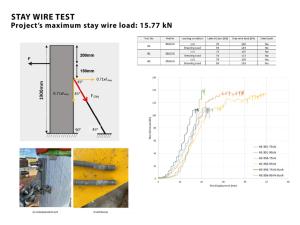
The stay system was equally important.
The Kawau Island design incorporated three stay wires per pole, making stay wire interaction fundamental to the overall structural performance of the line.
Testing undertaken by Wagners CFT helped provide confidence in how the stay system interacted with the FRP pole and connection arrangement under loading conditions relevant to the project.
More Than Just a Record Span
The headline is impressive. The world’s longest span achieved using an FRP utility pole.
However, the broader lesson is arguably even more important.
Kawau Island demonstrates that composite utility infrastructure can be confidently considered for demanding overhead line applications when it is supported by rigorous engineering validation and applied by experienced design teams.
It also highlights the importance of manufacturers investing in testing before projects require it.
By understanding bending performance, stiffness, connection behaviour and stay wire interaction ahead of time, manufacturers are able to provide designers with meaningful engineering data rather than assumptions.
That data does not replace engineering judgement.
It supports it.
Looking Ahead
Electricity networks are increasingly being challenged by difficult terrain, coastal environments, ageing infrastructure, resilience requirements and long-term maintenance pressures.
In that environment, FRP utility poles have an important role to play.
Their lightweight nature, corrosion resistance and long design life offer clear advantages, however their adoption in demanding applications must always be grounded in credible engineering evidence.
Kawau Island is a strong example of that balance.
It is first and foremost a testament to Vector’s engineering and execution. At the same time, it demonstrates the value of having properly tested and technically validated composite infrastructure available to support innovative network design.
For Wagners CFT, that is the role we aim to play within the utility sector, supporting designers and asset owners with infrastructure that is not only innovative, but properly understood.
Because when the material is tested, the data is available and the design is in capable hands, projects like Kawau Island become possible.