
A blog by Wagners CFT Business Development Manager, Robbie Westley (Connect via LinkedIn)
Contractors have spoken and they have told us that crush blocks slow installation, add unnecessary complexity, and can be frustrating to handle on site. So, Wagners Composite Fibre Technologies (CFT) have listened loud and clear, and acted on that feedback.
The result? Today’s Fibre Reinforced Polymer (FRP) pedestrian bridges and boardwalks are designed with significantly fewer crush blocks than five years ago, and you will only see them where they are structurally necessary to maximise connection capacity. No blanket inclusions, no wasted components, just smarter, more efficient design.
Fibre Reinforced Polymer (FRP) itself has transformed infrastructure across Australia. Lightweight, corrosion-resistant, and exceptionally strong, pultruded FRP profiles allow longer spans, slimmer profiles, and modular construction that is easier to transport and install.
By pairing these advanced materials with targeted connection detailing, we’re making installations faster, simpler, and more reliable, proving that listening to site teams doesn’t just improve workflows, it makes better infrastructure.
Listening to Contractors: What We’ve Learned
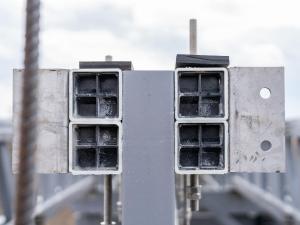
In early FRP designs, crush blocks were specified extensively; their purpose vital in the protection of hollow FRP profiles from local crushing under bolted connections. But over time, contractors consistently reported practical difficulties with these inserts:
- Slower installation: Each additional crush block adds handling, alignment checks, and assembly steps
- Complexity in sequencing: Especially on modular bridge or boardwalk systems, extra components can interrupt the flow of repeated installation cycles
- Tolerance issues: Misaligned crush blocks can introduce installation challenges and frustration on site
- Perceived unnecessary components: In locations with lower loads, inserts were sometimes more of a precaution than a structural requirement
We heard these challenges loud and clear. While safety and performance are never compromised, Wagners CFT recognised the need to refine specifications for greater efficiency and clarity. By analysing real-world feedback alongside engineering testing, we’ve developed a more targeted approach to crush block use.
Understanding Why Crush Blocks Were Used
To appreciate this evolution, it helps to revisit why crush blocks exist in the first place.
Fibre Reinforced Polymer (FRP) structural profiles, particularly hollow square tubes or I-beams, are anisotropic. They are extremely strong along the fibre direction but relatively weaker through the thickness of the laminate. When a bolt is tightened through a hollow section, the clamping pressure concentrates on the thin walls, creating potential for:
- Localised crushing
- Delamination
- Slow creep deformation
- Loosening of bolt tension over time
Without an insert, the bolt’s compressive load acts directly on the laminate walls, reducing connection stiffness and potentially compromising long-term performance.
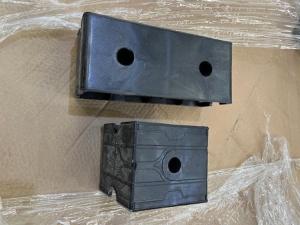
Anti-crush inserts sit inside the hollow section, directly behind the bolt. They take the compressive load, prevent wall indentation, and ensure the bolt load transfers cleanly across the section. This maintains bolt preload, joint integrity, and long-term structural performance.
In early FRP designs, this precaution was applied liberally, and in many cases conservatively. Every connection was fortified to minimise risk, often at the expense of installation speed and component simplicity.
The Mechanics of Load Transfer
A deeper look at load transfer helps explain why targeted use of crush blocks works:
- Without a crush block: The thin laminate wall under the bolt bears the full compressive stress. Even small indentations can reduce bolt tension, compromise stiffness, and create fatigue points
- With a crush block: The compressive force travels through a high-strength internal block. The bearing area increases, the walls are supported from within, and the joint retains its preload for the life of the structure
Testing consistently shows that well-engineered crush blocks improve connection capacity, reduce deformation, and enhance fatigue life. However, our recent studies and site observations indicate that not every bolt in a hollow FRP profile requires an insert.
By analysing load paths, torque requirements, and local geometry, we can now identify which connections genuinely need an internal support and which can perform reliably without it.
Fewer Crush Blocks Today
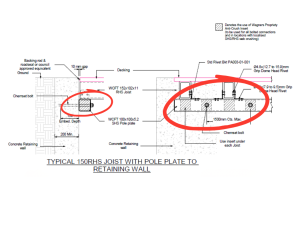
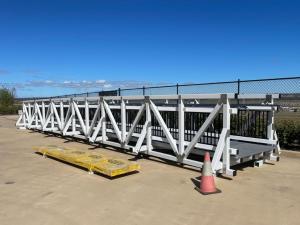
A modern Wagners CFT-designed pedestrian bridge or boardwalk has significantly fewer crush blocks than one from five years ago.
This doesn’t mean we’ve removed them indiscriminately. Instead:
- High-load or critical connections still receive crush blocks
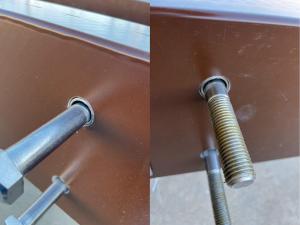
- Lower-load, repetitive, or less critical connections rely on bushes, optimised washers or even riveted connections, torque control, and connection geometry to achieve required performance
- Installation efficiency improves without compromising safety or durability
In practice, this evolution translates to:
- Faster installation cycles
- Fewer components to manage
- Reduced chance of misalignment
- Streamlined quality control
The difference may seem subtle on paper, but across a multi-span boardwalk or bridge with dozens of bolted connections, these refinements accumulate into substantial time and labour savings.
Example Case Study: Real-World Impact
Consider a modular pedestrian bridge with 120 bolted connections:
- Five years ago: Every connection received a crush block, adding 2–3 minutes per connection for insertion and alignment totaling 4–6 extra hours on site
- Today: Only 50% of connections require inserts, while the remainder use bushes or riveted connections. Installation time drops by nearly half, with fewer components to track and align
Contractors report smoother sequencing, reduced frustration, and fewer installation errors, demonstrating that design refinements based on site feedback improve both performance and constructability.
Why Connection Detail Matters
Connections remain the most critical aspect of FRP structures. Unlike steel or concrete, FRP connections are the frontier of design innovation. Every bolt hole, clamp, and washer placement influences:
- Load transfer efficiency
- Long-term fatigue resistance
- Localised stress concentrations
- Overall structural stiffness
Even with fewer crush blocks, engineers ensure that connection integrity is never compromised. In modern FRP systems, anti-crush inserts are one tool among many, deployed only where they deliver tangible structural benefits.
What’s Next: Choosing the Right Connection
Reducing crush block use is only part of the story. In upcoming content, we’ll explore:
- When to use a crush block vs a bush
- When riveted connections are appropriate
- How load type, environmental conditions, and installation methods influence connection choice
This discussion ensures that each joint is optimised for both safety and constructability; key factors in delivering smarter, more efficient infrastructure.
Benefits Beyond Installation
Refining crush block use isn’t just a win for contractors, it benefits asset owners as well from:
- Reduced labour costs due to faster installation
- Fewer components to manage and maintain
- Predictable, long-term performance
- Efficient, modular construction that simplifies transport and assembly
- Lower maintenance needs over the life of the asset
Ultimately, smarter detailing leads to lighter, cleaner, and more durable infrastructure.
Continuous Improvement
At Wagners CFT, refining crush block use is part of a broader philosophy:
- Listen to feedback: Real-world site experience informs design decisions
- Test and validate: Laboratory and field data guide performance thresholds
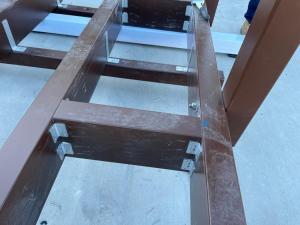
- Refine and evolve: Each project benefits from the lessons learned on previous installations
This commitment ensures that FRP structures continue to perform as designed, while minimising unnecessary complexity and cost.
Summary
Crush blocks remain a vital part of FRP design, but modern engineering allows us to be more targeted in their application.
Key takeaways:
- We’ve listened to contractor feedback and addressed installation challenges
- Crush blocks are now used only where structurally required
- A Wagners CFT designed bridge or boardwalk today has significantly fewer inserts than five years ago
- Fewer unnecessary components lead to faster, cleaner, and more predictable installations
- Follow-up content will explore when to choose a crush block, bush, or riveted connection, and how each solution supports structural integrity
The evolution of crush block use illustrates a broader principle: smarter design comes from listening, testing, and refining. By balancing performance with constructability, Wagners CFT continues to deliver FRP structures that are lighter, longer, cleaner, more resilient and while built to last for decades, still designed with those on site in mind.