
A century old road bridge has been reimagined as a modern pedestrian crossing complete with innovative flood-smart handrail system, preserving its history and securing its future.
Mt Crosby Weir Bridge on the Brisbane River in Queensland provided road access to local traffic for more than 100-years before being decommissioned in 2025.
But, given the bridge’s historic significance, owners Seqwater tasked global engineering firm GHD with finding a new purpose for the structure while at the same time protecting it from riverine flooding, regularly experienced on the Brisbane River.
This innovative retrofit and installation was led by GHD Technical Director – Bridges, Mat Williams and Pensar Project Engineer – Structures, Sam Strofield.
“For most of the bridge’s life, it just had a chain wire fence along the edge,” Mat Williams said.
“Then it went through a change with traffic barriers on the edge which resulted in extensive damage to the bridge after flood events,” Mr Williams said.
“The new Fibre Reinforced Polymer barriers are lighter and much quicker and easier to lay down in preparation of a flood event, which makes them far more practical,” he said.
“This bridge is 100 years old. It is at the end of its usable life as a road bridge and the road bridge wasn’t even in its original use.”
“So it’s fantastic to see it getting repurposed and able to be used for pedestrians and cyclists for the foreseeable future.”
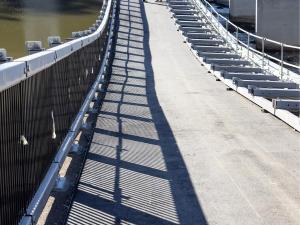 Pictured – The new FRP collapsible balustrade system.
The first bridge at this site was a timber structure that was ultimately wiped out by flood waters.
“The first crossing I’m aware of at this site dates back to 1884 approximately,” Mat Williams said.
“It would have been built at the same time as the East Bank Pumping Station,” Mr Williams said.
“The first bridge was an old timber bridge. It lasted about nine years before the first flood came through and completely wiped out the crossing,” he said.
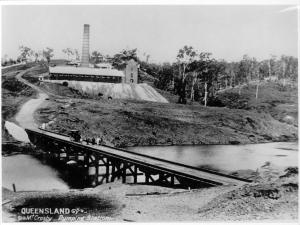 Pictured – The very first bridge at the Mt Crosby location dating back to approx. 1884.
The second bridge was more robust, surviving floods with minimal damage.
“The first bridge was wiped out in the early 1900s and a replacement was built,” Mat Williams said.
“This was a more robust construction and holds the title of the only previous bridge that hasn’t had significant damage from flood water,” Mr Williams said.
“It was only replaced when the weir was operated upstream of it. The remnants of the foundations for this bridge are still visible today underneath the new road bridge duplication that we completed a few years ago,” he said.
“In fact, a lot of that bridge was set out to miss these heritage listed foundations in the base there.”
“This second bridge lasted up until the weir was upgraded.”
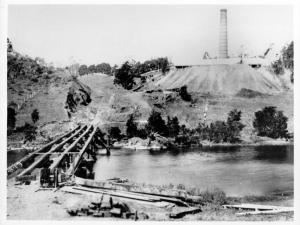 Pictured – The second bridge in 1913.
After the second bridge was washed out, a third bridge was built to carry trams.
“The second bridge still spanned the river downstream while the weir was getting built,” Mat Williams said.
“It lasted approximately one year until the first big flood came through. In 1927, one year after the bridge was complete, the full western approach was washed out,” Mr Williams said.
“One of the other key things worth pointing out is that even after the western approach was washed out, the tram tracks remained and still spanned where the approach used to be,” he said.
“The fact that this bridge was designed to carry a tram, its primary purpose is actually quite relevant to even the design of the balustrades we put in today.”
“That’s a key thing. This bridge was originally designed to carry trams backwards and forwards along the weir to aid construction but also to supply coal to that pump station on the east bank.”
“I believe it was only a year later they lengthened the bridge. So built in 1926, half wiped out 1927, lengthened in 1928 and that’s largely how the structure is still there today with a few strengthening and updates along the way.”
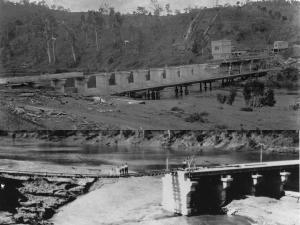 Pictured – The tram tracks of the bridge remained standing after flood waters wiped out the western approach.
The 2011 floods revealed critical weaknesses in the first folding traffic barrier system.
“In about 2000, the chain link fence on the edge was replaced with a folding traffic barrier system,” Mat Williams said.
“The 2011 floods were quite a considerable event for flooding in Brisbane and this was the first event where some of the issues with the folding traffic barrier system were identified,” Mr Williams said.
“In 2011, the balustrades were folded down in preparation for the flood and restrained as designed to be and they had done that before,” he said.
“These traffic rails are in 12 metre long sections. One of them came loose, I’m not sure how, whether it wasn’t tied down properly or if the actual tie down was damaged by debris or something during the flood.”
“But that section came off the bridge. It was connected at five points along the bridge deck and it tore all that concrete off with it.”
“That event really highlighted to the bridge owners how limited the capacity of the bridge deck edge actually was.”
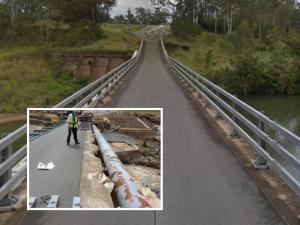 Pictured – The traffic barriers were damaged during the devastating 2011 floods.
A sudden 2022 flood exposed the bridge’s vulnerabilities again after the traffic barrier system couldn’t be put down in time.
“There was another flood event in 2022 just before the construction of the bridge duplication downstream,” Mat Williams said.
“In this event, I believe the flood water came up very quickly and there wasn’t actually time to get in there safely and fold down the traffic rail system before the event,” Mr Williams said.
“The full folding traffic rail system was left up and got the brunt of the full flood water and it came off the whole length of the bridge,” he said.
“All the unreinforced pieces of concrete were pulled out with the posts showing how weak the actual edge of the bridge deck is.”
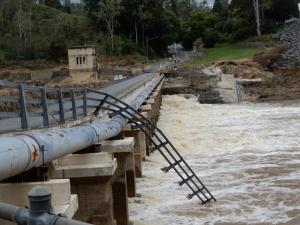 Pictured – The system was not laid down prior to floods in 2022 resulting in extensive damage.
With heavily reinforced beams supporting the tram tracks but largely unreinforced side sections, the bridge deck faced significant stress during floods and fast-moving debris.
“The tram tracks are in the middle of the bridge. Immediately underneath those tram tracks, there are two considerable beams that are heavily reinforced and provide a lot of support for the tram,” Mat Williams said.
“There are beams on the edge which are well reinforced as well and provide resistance, but the bridge deck in between these beams is largely nominally reinforced,” Mr Williams said.
“The bridge was designed to carry the tram traffic. Apart from that, it would have been foot traffic or very small vehicles, horse and cart sort of things probably at the time so there’s fairly normal mesh in the bottom,” he said.
“Apart from that, the bridge deck is largely unreinforced. So it’s not surprising under the huge flood forces that it’ll just tear the concrete off an unreinforced piece of concrete on the side.”
“At the peak of those flood forces, the flood can be up to about 5 metres per second coming through here so a lot of water moving very fast with a lot of debris from upstream.”
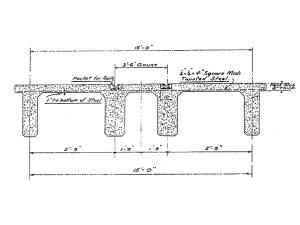 Pictured – A snippet of the original 1926 drawings for the bridge including the tram tracks.
The old traffic rail system was heavy, slow to operate and vulnerable in floods, prompting Seqwater to seek a much lighter, easier-to-handle replacement.
“The traffic rail system that was there until recently was damaged in a few of those flood events,” Mat Williams said.
“Another key point is each of those segments weighed approximately 700 kilos from memory. Whatever the number was, it was far too heavy to be folded down by hand,” Mr Williams said.
“This required lifting equipment or forklifts on the bridge to actually fold it down,” he said.
“Before we built the duplication bridge, this was the highest bridge for this local area so it was always left open as long as possible to give safe access to residents.”
“It was always a race against the clock to come and fold these barriers down and you needed lifting equipment that was slow and heavy to actually fold down the length of the bridge.”
“So Seqwater were again very keen to see a much lighter weight system when they actually replaced these.”
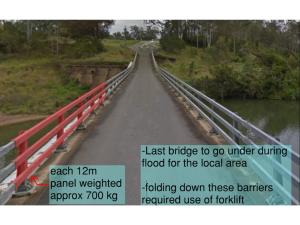 Pictured – Each 12 metre panel weighed approx. 700 kilograms requiring heavy equipment to put down.
Seqwater tasked the GHD team with designing a safer, lightweight retrofitted balustrade system.
“After discussing some of these constraints at the site after the new bridge was built in 2023, Seqwater engaged us again to design the retrofitting for this new balustrade system,” Mat Williams said.
“First we considered quite a few options of how to do this. One of them was just can we accept what’s there? The short answer was no,” Mr Williams said.
“As it is, it’s just not suitable. With big gaps between the traffic rails, you can’t use that as a balustrade system. A child could crawl directly underneath those barriers and various other issues as well,” he said.
“So we considered what’s already there and attaching additional elements to it to make it a suitable barrier.”
“However, the weight was still quite a big issue of these systems. Anything we added to it was just going to make the weight folding this down even more of an issue.”
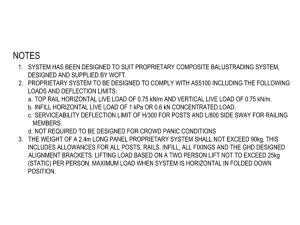 Pictured – A brief summary of where GHD started with Wagners.
Early in the project, the GHD team partnered with Wagners CFT to leverage their expertise in lightweight structures.
“At this stage of the options development is when we first contacted Wagners knowing that they had a lot of experience with lightweight structures and barrier systems and in this area,” Mat Williams said.
“The first contact with them described what the problem was and they were confident that they’d be able to work with us to develop the system,” Mr Williams said.
“Like any other project, the first thing we had to do was define the requirements. Minimum load capacities, the strength of the system had to be able to resist deflection limits, these are all just requirements straight from AS5100,” he said.
“Like any other balustrade on a bridge, it had to be designed to satisfy that and the only extra requirement was the maximum weight that each panel could be so that it could easily be folded down by two people in the hinged arrangement.”
“We quickly got traction working with Wagners. We had an idea of what we wanted by leveraging their strengths, whether it was their experience with their products and all their in-house knowledge, they also had specialists that we could engage with.”
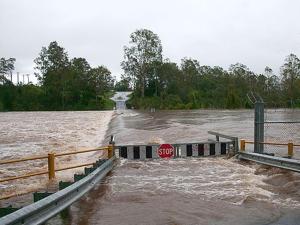 Pictured – The bridge underwater during the 2011 floods.
The innovative hinged base plate design lets each FRP panel operate independently, reducing weight while ensuring smooth folding and secure flood restraint.
“In the final concept, the hinged base plate actually supports two completely separate posts rather than one common post, meaning that every single panel has its own post that can be folded down fully independently of the panel beside it, so straight away that limits weight considerably,” Mat Williams said.
“All the hinge components are base plate located and sort of hidden underneath that bottom rail on the rear there. You can also see some location plates. This system didn’t have any spigots or rail connectors between them,” Mr Williams said.
“Every panel stays independent except for those two plates at the back which are bolted together to keep alignment,” he said.
“After they’re folded down for a flood, they’re lifted back up and aligned. There’s no snagging points and it also looks quite presentable.”
“The back of that alignment bracket at the top also has some holes where we attach the actual restraint. When it’s folded down, they’re tied down together and can’t be lifted up during the flood water.”
“And so this design concept is largely what was actually fully developed, designed and built.”
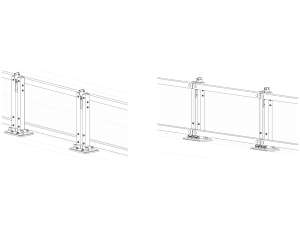 Pictured – Rear view (left) and front/pedestrian view (right) of the design concept.
Strict heritage requirements meant the team had to work with existing bolts, making careful planning and precision essential for a smooth installation.
“There was a fair bit of planning involved in getting these in. Because of the heritage acts requirements, we weren’t allowed to drill into the existing concrete deck so we had to work with the original hold down bolts that were already in place,” Sam Strofield said.
“That meant accuracy was absolutely critical,” Mr Strofield said.
“Mat was closely involved in reviewing the shop drawings for these base plates along with the 3D scans and conventional surveys to make sure that the holes in the base plates lined up perfectly with what was on site,” he said.
“We spent a lot of time planning and double checking everything and it definitely paid off, everything went really smoothly.”
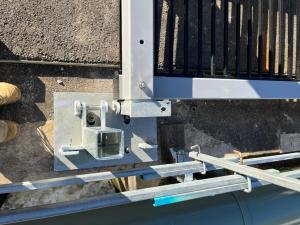 Pictured – One of the FRP panels from Wagners attached to the folding base plate.
Installing the FRP balustrades on a 100 year old bridge presented unique challenges.
“One of the main challenges that we came across was the bridge itself being built in 1926, It wasn’t level, however, the FRP balustrade system was designed to sit level,” Sam Strofield said.
“Because of that, the existing hold down bolts weren’t long enough for all 150 base plates to sit level with each other,” he said.
“We came up with an idea of using couplers to sit underneath the base plate to get that additional length; however that was not going to work because there were a few variables that would have pushed the balustrade system out of spec.”
“With guidance from Pensar, Seqwater made the call to install all base plates 15 millimetres off the concrete deck. Looking back at that, this was the right call.”
“Once all 150 base plates were in position and set, we moved onto installing the FRP balustrade system.”
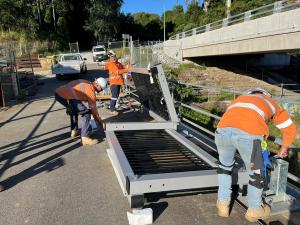 Pictured – Pensar installing the FRP panels along the bridge.
With careful planning and precise coordination, the 140 FRP panels were installed smoothly.
“We coordinated the delivery of the 140 preassembled panels in two separate loads and we started from one end of the bridge being the East Bank end,” Sam Strofield said.
“The process itself was pretty straightforward. We removed the bolt connecting the bottom rails to the vertical member, slid the FRP system over the stub and reconnected that bolt back in place,” Mr Strofield said.
“Again, thanks to the planning and drawing views and survey verification and with Mat heavily involved throughout, every panel fit perfectly and as intended,” he said.
“Once all the panels were in, we attached all the alignment brackets, grouted, placed locking pins and essentially that was the installation process throughout the full length of the structure.”
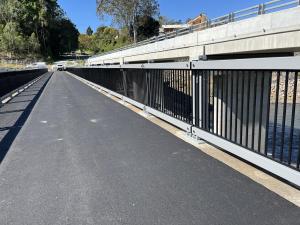 Pictured – The completed FRP system.
Designed for maximum resilience, the FRP panels are securely tied down when folded, minimising damage during floods and making repairs easier if needed.
“When they’re folded down, the panels are tied together and restrained for when the flood waters actually come through,” Mat Williams said.
“The previous traffic barriers had about 12 metre long panels with a fairly similar system to this, just a tie essentially holding them down, tying them to each other and stopping them lifting during the flood,” Mr Williams said.
“That was for a fairly large 12 metre section that could be picked up or damaged,” he said.
“To avoid having that same damage again, we have aimed to have the most robust system that we could.”
“For the FRP system, there is one tie down for each pair of panels so when they’re folded down, there’s a lot more restraint per area of balustrade.”
“But also because they’re broken into separate panels, if something was damaged or one of these ties wasn’t installed correctly for any reason, it should be quite isolated for a repair as opposed to damage on earlier bridges where it was like a zipper pulling off concrete the full length of the bridge.”
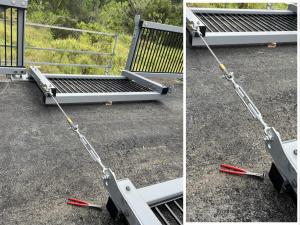 Pictured – The tie down system for when the balustrades need to be laid down for a flood event.
The FRP system can be collapsed in just an hour, reducing manual labour and increasing safety.
“Generally two men could get down there and get one side done within half an hour and the other side again in another half an hour so I would say an hour max,” Sam Strofield said.
“The panels weigh about 50 kilos, so they are very lightweight, meaning two men could handle them easily and get the job done within the hour for sure,” Sam Strofield said.
“With flood waters rising, speed is crucial and the FRP system is much quicker to take down than the previous balustrade systems,” he said.
“Because it’s so light and easy to manoeuvre, workers can remove it quickly without the need for heavy machinery, making the process safer and more efficient in emergency situations.”
Watch the full webinar ‘Transforming Heritage Through Smart Retrofitting’ featuring Mat Williams and Sam Strofield – https://www.youtube.com/watch?v=vvaz7PVF0vY&t=1623s
Read ‘Preserving history, embracing innovation: The smart repurposing of Mt Crosby’s Weir Bridge – https://www.wagnerscft.com.au/preserving-history-embracing-innovation-the-smart-repurposing-of-mt-crosbys-weir-bridge/
Want to explore a collapsible FRP handrail system for your project? Reach out to your local Business Development Manager – https://www.wagnerscft.com.au/contact-us/
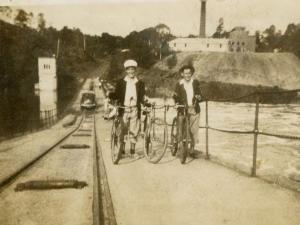 Pictured – Pedestrians, cyclists and a car using the bridge in 1940 which features the chain link fence and tram tracks.