
A blog by Mark Baker – NZ Country Manager, Wagners Composite Fibre Technologies (CFT)
Over the past decade, New Zealand’s electricity networks have undergone a quiet but important shift. As the need for greater resilience, lighter materials, faster restoration, and long-term asset durability grows, composite crossarms have moved from niche to mainstream and today, more than half the networks in the country rely on them.
But as composite options become more readily available, the question is no longer “Why composites?” For most networks, that question has already been answered.
The real question, the one I’m asked weekly, is this:
“What makes Wagners CFT different from the other composite crossarms on the market?”
It’s a fair question. Many brochures look similar. Many suppliers talk about strength, durability, corrosion resistance, or compliance. And yet, when you dig below the surface, the similarities quickly disappear.
After eight years supplying composite crossarms into New Zealand, and over 25 years manufacturing them across Australia and internationally, I’ve had the privilege of working closely with asset engineers, line crews, planners, and procurement teams across the sector. What they tell me, consistently, is this:
Wagners CFT isn’t just another composite option. We’re the composite crossarm supplier that has earned the confidence of New Zealand networks through transparency, testing, traceability, durability, and the sheer amount of real-world proof behind our product.
Below is a deep dive into the reasons why.
1. We Publish All Our Test Results, Not Just the Ones That Look Good
If there is one thing that truly sets Wagners CFT apart, it is our openness.
Every composite supplier claims strength. Every supplier claims durability. Very few publish the actual test results.
At Wagners CFT, we’ve taken the opposite approach: we publish the results of all of our testing online, not just the headline values, not just the tests required for a particular standard, and not just the results from one point in time.
Why do we do this?
Because networks across New Zealand operate under different design philosophies, loading conditions, voltage levels, insulation systems, and environmental constraints. A single benchmark may not reflect the parameters you actually design to. Transparency allows engineers to make decisions based on the full performance capability of the product, not a pass/fail statement against a narrow criterion.
We regularly conduct more than 30 different tests across mechanical, electrical, material, and environmental performance. These include:
- Tensile, flexural, and shear performance
- Full-scale mechanical loading
- Insulator interaction testing
- Electrical and tracking resistance testing
- Fire resistance
- Moisture ingress
- Both UVA and UVB exposure testing
This is not a sample set, it’s an ongoing program. Our crossarms have been tested more than any other composite arm in the region, and the results are publicly accessible.
For networks that value engineering clarity, this matters.
Click here to access Wagners CFT Crossarm Technical Information Guide which includes testing results.
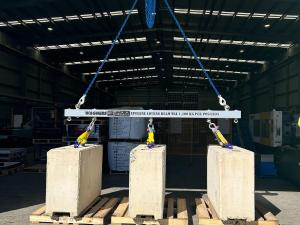
Pictured – Wagners CFT crossarms are subjected to extensive testing by our internal R&D team at our Wellcamp manufacturing plant in Queensland, Australia.
2. Our UV Testing Far Exceeds Anything Done in the Northern Hemisphere
Australia and New Zealand sit under some of the harshest UV conditions in the world.
This is well known by anyone working in materials engineering, but it’s often overlooked by manufacturers who benchmark their products against European or North American standards.
We don’t.
Wagners CFT have subjected our crossarms to 45,000+ hours of UV testing across both UVA and UVB. This is far more than what is typically tested in the USA or Europe, because the UV index those regions face simply isn’t comparable.
Why does this matter?
Because UV degradation is cumulative, and choosing a product tested only to northern hemisphere benchmarks means accepting an unquantified risk in New Zealand conditions.
Our philosophy is simple:
Test to the environment you live in, not the environment someone else lives in.
See page 8 of Wagners CFT Crossarm Technical Information Guide to learn more about our Environmental Element Testing including Ultraviolet Resistance against the standard ASTM G154-02.
3. Built-In Anti-Crush Blocks Installed at the Factory
One of the recurring issues networks face with certain composite crossarms is deformation when hardware is tightened. In the field this can mean:
- re-tightening hardware
- unpredictable long-term behaviour and risk of fatigue related failures
- Increased maintenance costs and unnecessary time on site
Wagners CFT avoids this by installing anti-crush blocks at the factory, ensuring the engineered product meets the requirements of AS/NZS 1111.
This design feature ensures:
- no deformation under tightening
- no need for post-installation re-tightening
- consistent long-term support of every bolted connection
It is one of the simplest examples of where design experience translates directly into reduced operational risk.
4. Coextruded Thermal Plastic Alloy Coating for Reduced Tracking
Anti tracking is one of the most critical performance requirements of crossarms. Our coextruded thermal plastic alloy coating significantly reduces tracking risk and is applied consistently across all production.
Some would argue that this coating makes the crossarm more “slippery” to handle. And yes, in exchange for reducing electrical tracking, the surface is smoother.
Networks have overwhelmingly preferred reduced tracking risk over marginal handling differences. And with basic handling adjustments (gloves, or inserting a bolt through a hole when lifting), crews have found no practical issue.
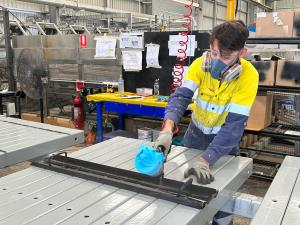
Pictured – All Wagners CFT crossarms are coated with a co-extruded thermal plastic alloy that has been rigorously tested against the effects of electrical tracking and UV protection.
5. Coating Durability—A Concern That Doesn’t Match Reality
Another comment we occasionally hear is that Wagners CFT’s coating can be “damaged easily.”
To be clear:
- Minor cosmetic damage to the coating (under ~25 mm) is not a structural concern.
- The consequence of this kind of surface mark is significantly less than the risk posed by a drilled hole left unsealed in other composite designs.
- The only meaningful risk associated with coating damage is the potential for blooming—a surface effect that also occurs in uncoated composite products.
More importantly, simple modifications to product handling avoid the issue entirely.
Real-world evidence tells the full story:
With more than 2 million Wagners CFT crossarms in service across Australia and New Zealand, coating performance has never been a systemic issue.
For more information on Why Wagners CFT Paint Their FRP Pultruded Profiles Instead of Just Using UV Inhibitors, check out this article.
6. Field Drilling Isn’t Necessary, and Alternatives Already Exist
Some would say that “you can’t field drill a Wagners CFT crossarm.”
In practice:
- You can attach small items, like labels, directly to the arm with self tapping screws.
- Clamps can be fitted anywhere they’re needed.
- If a network requires a long-term attachment point, we can modify the design.
- And we happily produce small-volume, bespoke versions when needed.
The reality is that the perceived need for field drilling often arises from legacy timber practices. Composite behaves differently, and for good reason.
Across 18 New Zealand networks (with six more running trials), field drilling has not been an operational concern.
7. Strength Claims Need Full Transparency, Not Selective Data
We sometimes hear competitors say, “Our arm is stronger than Wagners CFT’s.”
Strength in FRP is influenced by:
- fibre direction
- fibre type
- resin chemistry
- resin application
- wall thickness
- manufacturing method
A single test result doesn’t paint the full picture.
That’s why we publish more than 20 mechanical test results, each tied to a specific AS/NZS testing standard.
We also offer two profiles:
- 100 × 100 mm (used widely across NZ)
- 125 × 125 mm, which is around double the strength of the 100 × 100 mm and stronger than competing arms tested
But here’s the interesting part:
Despite having access to the higher-strength profile, most NZ networks haven’t required it, because the 100 × 100 mm profile comfortably meets their needs.
This reinforces a key point:
It’s not about theoretical strength, it’s about the right strength for the right application, backed by full transparency.
Watch this webinar featuring Wagners CFT Chief Technical Officer discuss It’s What’s Inside that Counts! regarding the strength and exceptional performance of Wagners CFT crossarms.
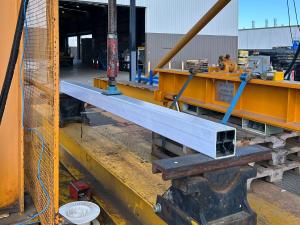
Pictured – A full scale three point bend test is done on Wagners CFT crossarms to verify their mechanical strength.
8. A Product Line Constantly Improved Over 25 Years
Wagners CFT has been manufacturing composite crossarms for over 25 years. In that time, we have continually refined:
- resin systems
- fibre alignment and volume
- coating systems
- manufacturing consistency
- quality assurance
Every year, every iteration, every improvement is folded back into the product.
This is why Wagners CFT is not simply “a manufacturer of composite crossarms”; we are the longest-standing, highest-volume, most-tested composite crossarm supplier in our region of the world.
And we bring that experience with us into every conversation with networks.
9. New Zealand Networks Trust Us, Because the Product Has Proven Itself
Today, 18 of New Zealand’s 29 networks actively use Wagners CFT crossarms.
Another six networks are currently running field trials.
The scale of adoption has grown for one key reason: in real-world conditions, over many years, the product performs.
Add to that:
- strong stock availability in New Zealand
- Australian manufacturing (avoiding volatile international freight cycles)
- price stability over the past eight years, broadly aligned with inflation
- local technical support backed by the people who actually manufacture the arms
and it becomes clear why our product has become the default choice for many networks.
10. Standardised Designs Support Network Resilience
As storms, floods, and natural disasters increase in frequency, networks are prioritising interoperability and rapid restoration.
Wagners CFT’s standardised designs are now widely adopted across the country, meaning:
- inventory can be shared
- crews can work across regions with familiar equipment
- replacement stock can be deployed quickly
- exposure to bespoke, slow-to-replace components is reduced
And where bespoke designs are needed, we support that too, just without locking networks into low-volume product dependencies.
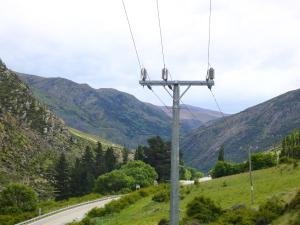
Pictured – Wagners CFT crossarms in the Aurora Network in Central Otago, New Zealand. Photo by Rob Wiltshire.
Why Networks Choose Wagners
When asset managers, overhead designers and procurement teams summarise why they choose Wagners, these are the themes that emerge consistently:
- Transparency — full published testing
- Proven performance — +2 million arms in service
- Designed for NZ conditions — especially UV
- Manufactured in Australia — stable supply and pricing
- Continuous improvement — 25-year track record
- Engineering support — from the actual manufacturer
- Adoption across the country — trusted by 18 networks
- Product availability — strong NZ stock levels
- Standardisation — enabling resilience and rapid restoration
In short, networks don’t just choose Wagners CFT because our composite crossarms are good.
They choose Wagners CFT because our product is tested, proven, transparent, continually improved, and backed by the most experienced composite manufacturer in the region.
That is why Wagners CFT is the preferred composite crossarm in New Zealand.