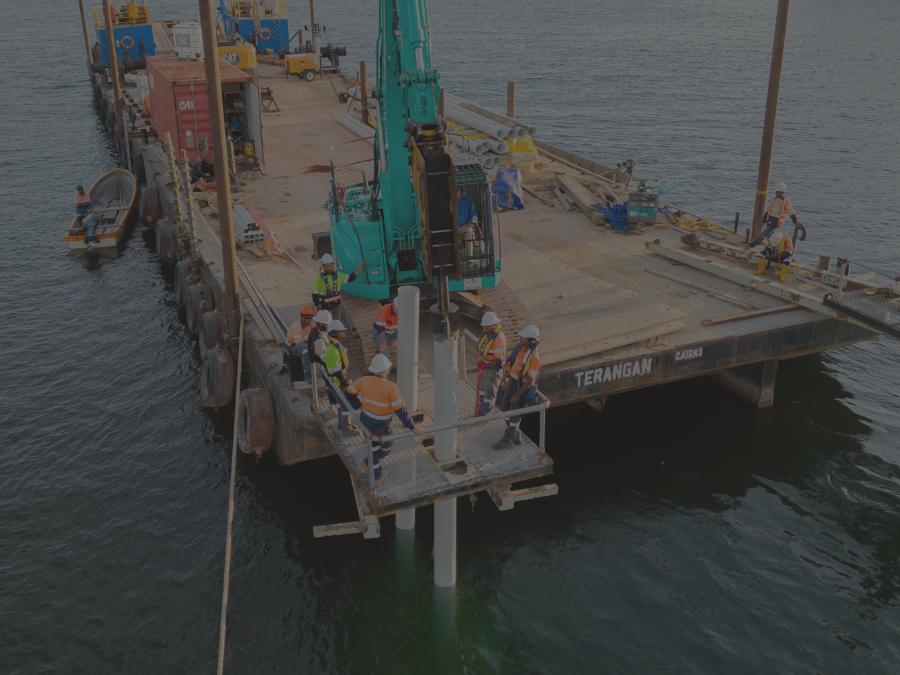
Piling contractors using Fibre Reinforced Polymer (FRP) piles are getting jobs done faster and more efficiently than ever before.
That’s according to Wagners Composite Fibre Technologies (CFT) Project Manager, Daniel Allen who said FRP piles are quickly becoming the go-to-choice for modern infrastructure projects thanks to the ease of installation which is translating into improved profits for contractors.
“The biggest factor driving profitability for contractors is that FRP piles can be driven directly into the ground without the extra preparation traditional materials often require,” Daniel Allen said.
“Because the piles are so lightweight, contractors can use smaller, less expensive equipment during installation, delivering immediate cost savings,” Mr Allen said.
“The ease of handling FRP piles shortens installation timelines, allowing crews to complete more work in less time,” he said.
“The material’s inherent corrosion resistance further reduces long-term maintenance costs, significantly improving lifecycle value for asset owners.”
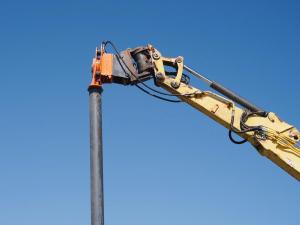 Pictured – Pile installation for a Gold Coast boardwalk being completed with a vibration hammer.
When it comes to adaptability in challenging ground conditions, FRP piles are a standout choice.
“FRP piles are great in all kinds of soil conditions from sandy loam to clay and silty soils, especially great for acid sulfates,” Daniel Allen said.
“They can be used on a whole heap of different projects. We’ve done bridges, boardwalks, jetties, pontoons,” Mr Allen said.
“Generally things around the marine setting is where you really get bang for buck, but FRP piles can be used in almost any piling application,” he said.
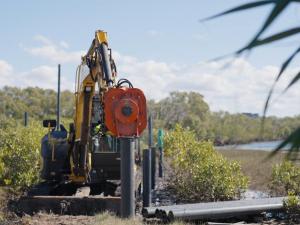 Pictured – A vibration hammer completing piling for a boardwalk in Queensland.
There are three main ways to install FRP piles, depending on the soil and project needs.
“We use three general different types of piling applications, your traditional drop hammer, so a weighted drop hammer, your vibration hammer, so steady vibration pile, and then your impact hammer, which is a smaller repetitive impact,” Daniel Allen said.
“They each have their pluses and minuses. I think the best for our piles is vibration because it works in all different types of soils,” Mr Allen said.
“Vibration hammers disperses soils really well and disperses small rocks, so you can pile into slightly rocky areas,” he said.
“It just depends on what you’re using, but we use a bunch of different pile adapters on different machines.”
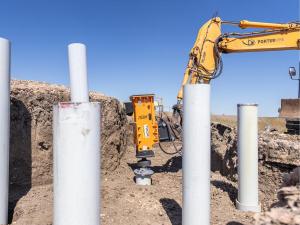 Pictured – A thor hammer in action during piling in south west Queensland.
Getting the right setup is key to making your piling equipment work seamlessly on site.
“Obviously, you’ll have to get the hitch specifications of your machine and match them to the equipment coming in,” Daniel Allen said.
“You can pretty much add our vibration hammer to any one of the machines as long as the hitch sets there. It goes from a 5.5 ton all the way up to a 25 ton so plenty of options,” Mr Allen said.
“You just have to understand how to use your digger and how to use a drop hammer for the heights that you’re dropping it from and the weight you’re dropping it from,” he said.
“Send those calculations to our design team and they can facilitate a drop hammer set.”
“If you’re not sure how to do the testing, we encourage contractors to reach out to Wagner CFT. We can facilitate a drop hammer set table.”
“We have all three items, a drop hammer, a vibration hammer, and an impact hammer that we can hire out for contractors on their jobs if they aren’t wanting to buy it themselves.”
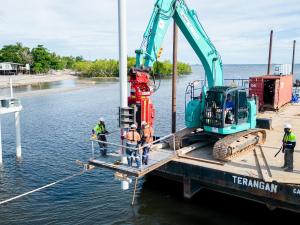 Pictured – Preparation of an FRP pile for installation in Papua New Guinea.
Installing FRP piles is a lighter, simpler process from start to finish.
“With an FRP pile, it’s generally proposed that you stand the piles up and push them slightly in to get them set in position,” Daniel Allen said.
“Then you can put your vibration hammer or impact hammer over the top of it, pile it in until you’re getting a refusal set, and then you swap over to your drop hammer to complete the set,” Mr Allen said.
“One of the great things with FRP is obviously how lightweight it is compared to say a concrete pile,” he said.
“With concrete, you have to use the machine to stand the pile at all times. You’re dealing with a piece of plant to put that pile in for the whole duration of the project.”
“With FRP, you can hand stand them depending on the size and the profile. You can also use a smaller machine and use the pile head adapter to stand the piles as well.”
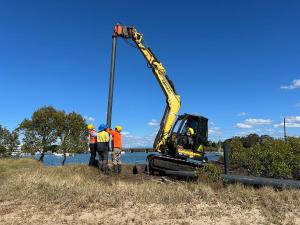 Pictured – A first-time FRP pile user successfully completing piling on the Gold Coast with the guidance of Wagners CFT Project Manager, Daniel Allen.
Splicing FRP piles is straightforward, allowing you to reach any required depth.
“One of the disadvantages of piles or advantages sometimes is the fact that you’re going to keep going deeper and deeper as you understand the ground profile better,” Daniel Allen said.
“Wagners CFT piles can be easily spliced, so just a bolted connection with an internal ID smaller CTF member that goes inside the pile and then you can easily splice them with bolts and keep sending them down,” Mr Allen said.
“The integrity of the splice isn’t impacted from putting the splice in, it’s as strong as the actual pile itself,” he said.
“You can get all the testing you want done, but unless you’re testing every single hole and spending all your money up front, you’re never really going to know what’s underground.”
“The splicing benefit is huge as you can just keep connecting them over and keep going deeper as required to get your set.”
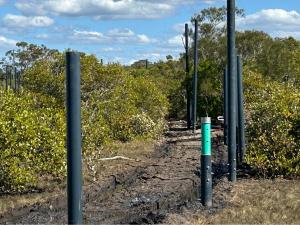 Pictured – Multiple spliced FRP piles installed for a boardwalk project in Queensland.
FRP piles are easy to protect, cut and manage safely on site.
“The pile cap that we recommend is a hard rubber. We obviously don’t want to take too much shock from the drop hammer or the impact hammer but you want to try and protect the pile if you can,” Daniel Allen said.
“If you have any cracking or degradation to the top of the pile while you’re piling, you can just cut it off and keep going. Or if you’re at a low set, you can splice it and then also keep going,” Mr Allen said.
“Cutting FRP piles is fairly simple. You are just going to use your normal cutting disc and grinder with a diamond tip blade. We also use backpack vacuums around the cut location to prevent any dust going into the environment,” he said.
“One of the advantages of FRP is the simplicity of cutting it on site. You can cut other traditional piles on site, but they’re quite intensive whereas FRP is a one man job.”
“For example, a concrete cut pile would involve quite a large plant or cutting system to get through it, so cutting FRP is a lot easier.”
“You’re always trying to be safe when cutting any kind of pile. With FRP piles, it’s so lightweight.”
“Because you’re using hand tools, it can be managed a lot better than using a large plant. Not having a large plant around reduces the risk factor.”
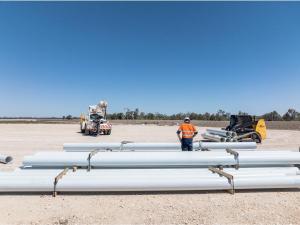 Pictured – A contractor inspecting FRP piles prior to piling commencing.
FRP piles prove flexible and resilient, even for first-time users on site.
“On my first FRP piling job, I was quite apprehensive not having piled FRP before. I was worried about damage to the top of the pile or damage to the pile if it hit a rock,” Daniel Allen said.
“The concerns seem to be unfounded. I’ve been piling on projects for eight years and we’ve not had any issues with any damage or degradation to the top of the pile cap. We can just cut it off and keep going,” Mr Allen said.
“We may hit refusal, we may not, and then have to splice. So there’s just a lot of flexibility in piling with FRP,” he said.
“You’ve got piles that you can cut to size and length whatever you require. You can splice them to length so you keep going. We’ve piled over 12 metres deep with our Wagner CFT piles.”
“You’re getting a lot of the benefits and there doesn’t seem to be any issues.”
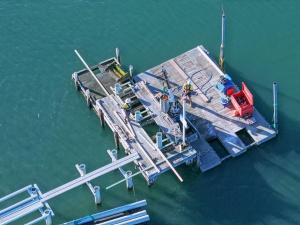 Pictured – Piling underway with a drop hammer on a jetty project in Victoria.
FRP piles are rapidly gaining ground, showing they can rival and even outperform traditional materials.
“You see it a lot. That great unknown of using a new product versus your traditional steel, timber and concrete which are used every day all over Australia,” Daniel Allen said.
“FRP is the new kid on the block so you do get a lot of questions. I find them mostly to be totally unfounded,” Mr Allen said.
“We’ve done multiple piling projects up and down the Australian coast, both as a principal contractor and working with contractors, so we see a lot of success along the coastline,” he said.
“Some of the great ones are up in Townsville near the Townsville Stadium boardwalk, all around the Gold Coast coastline and Sunshine Coast coastline, all the way down south to Melbourne. So it’s everywhere.”
“With its proven durability, corrosion resistance and long-term performance, FRP piles are fast becoming the smart, sustainable choice for Australian infrastructure.”
To watch the full video featuring Wagners CFT Project Manager, Daniel Allen – https://www.youtube.com/watch?v=8TB_cR5E-N8
Read ‘Driving progress: Wagners FRP profiles redefine piling’ – https://www.wagnerscft.com.au/driving-progress-wagners-frp-profiles-redefine-piling/
Have a question about piling with FRP piles? Reach out to your local Business Development Manager – https://www.wagnerscft.com.au/contact-us/